MMRA Endorses Mid City West Trolley Plan

[From the November 2013 edition of the MMRA newsletter:]
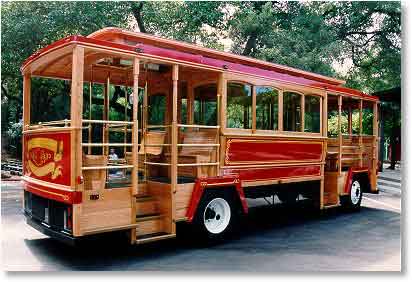
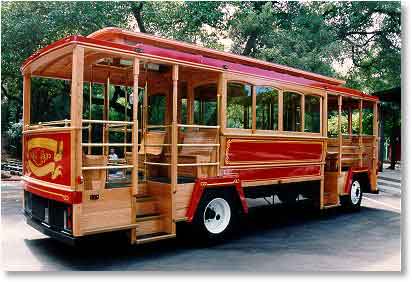
preferred trolley

The Mid City West Trolley Plan

[or how to get you husband to leave the car at home…]

Last June billionaire developer Rick Caruso introduced the idea of an extension of the Grove’s fixed rail trolley to connect the popular shopping center with Museum Row at Wilshire and Fairfax. Recently, it was announced that the Los Angeles Museum of Art had teamed with Caruso to study the proposal. The results of an engineering study Caruso commissioned are expected later this month.

But several years before Caruso’s plan, Julie Anne Brame had a problem. Brame, who lives in the Crescent Heights/Melrose area, likes to walk – her husband doesn’t. After work, Brame would often encounter resistance from her husband when she suggested that they walk down to 3rd Street to try one of the many restaurants there. He would usually prefer to drive, even though parking is always difficult. Out of her idle wish that there were some easy way to quickly get around the area – so that she could get her husband out of the house without driving – came an idea: the Mid City West Trolley.

Brame is a resourceful woman and persistent, too. She kicked around the idea with like-minded friends and a plan evolved to have a rubber wheel trolley that would connect Melrose, Fairfax, the Grove, the Miracle Mile, La Brea, 3rd Street, the Beverly Center, and the Cedars-Sinai medical complex. She and her supporters did their homework, studying successful rubber wheel trolley projects across the country.
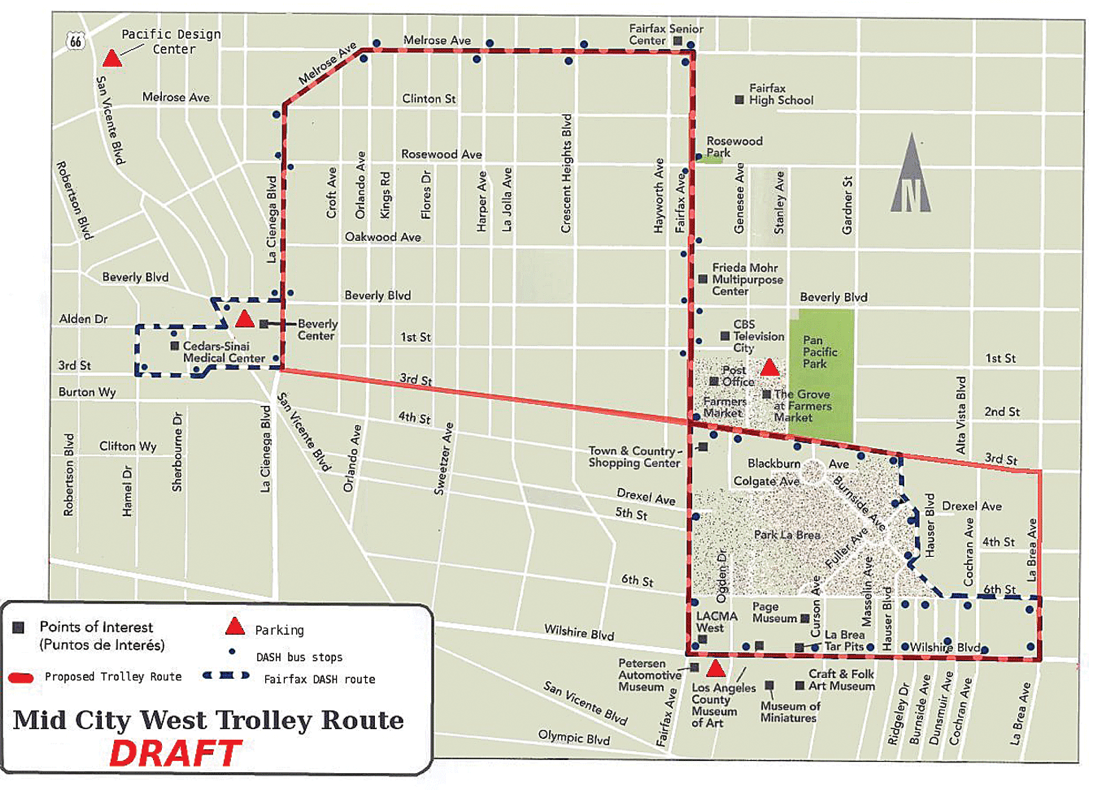
Trolley map

They took a fresh and modern approach to develop a program that would connect densely populated neighborhoods, existing parking garages, and popular destinations to facilitate circulation and reduce local automobile traffic. Their target riders would be residents, business patrons, employees, students, and tourists.

Their research helped them devise a check list: the trolleys would have to come every 15 minutes, their time of arrival easily monitored via a GPS smart phone app, they would have to provide free wifi access for passengers, and be comfortable and fun. The trolley program would also have to be flexible to allow for route expansion and to navigate around obstacles, like the upcoming subway construction in the Miracle Mile.

They knew that to succeed their trolley would need savvy marketing and promotion and both private and public support. And it would take a lot of outreach. That’s when Brame looked around for a way to learn the ropes and promote her trolley plan. So, in 2011 she got herself elected to the board of Mid City West Community Council [MCWCC]. As she got the lay of the land – how things get done in L.A. – she began to pitch her trolley idea to fellow board members, representatives of homeowner and residential associations, City council members, and anyone else who would listen.

Her skills of persuasion and well thought out approach began to win fans. She did not have to make a hard sell: ever worsening traffic congestion constricts travel and commerce in the area and the advent of the Purple Line subway extension makes “first mile-last mile” transportation from subway stations imperative. And the projected one million visitors a year to the soon-to-be Academy Museum at the former May Company will only exacerbate gridlock along Fairfax. The consensus was clear: something had to be done.

Soon, MCWCC endorsed a motion in support of studying the feasibility of Brame’s trolley plan, Councilmember Tom Labonge publicly announced his support at recent meeting of the Miracle Mile Chamber of Commerce, and the Miracle Mile Residential Association will consider a motion in support of the project at its upcoming board meeting on November 7th. And even Rick Caruso gave a nod to the Mid City Trolley by asking his engineers to include a review of Brame’s plan in the study of his fixed rail trolley, which many residents strongly oppose on grounds that it would only further clog traffic and present many safety issues.

While Caruso’s fixed rail trolley grabs all the headlines, Brame’s rubber wheel trolley steadily gained traction. Brame is clear that her plan is very much a work in progress and that the current proposed route could and probably will change depending on which parts of the area are most supportive. Hence, the inherent advantage of a rubber wheel trolley – the route can be expanded to meet new demand and include more of the Mid City West area.

The Los Angeles Department of Transportation would operate the system, but the financing is complex. It will take a mix of private and public money to get the trolley rolling and, long term, it would take an ongoing financial commitment from the City to sustain it. Although, Brame aspires to follow the example of other successful rubber wheel trolley programs that generate substantial income from advertising revenues.

The initial plan is to begin on weekends to test the concept with service beginning of Fridays from 6 PM to midnight; Saturdays 10 AM to midnight; and Sundays from 11 AM to 10 PM. If this pilot plan succeeds service would be expanded to 7 days per week.

And, perhaps – in a year or so – Brame and her husband (and the twins she is soon expecting) will be able to leave their car at home when they go out for dinner.

[A motion endorsing the Mid City West Trolley Plan was adopted by the Board of Directors of the Miracle Mile Residential Association at our November 7, 2013 meeting.]
Tar Pits Threatened by LACMA Expansion; MMRA Approves Motion to Preserve Green Space in Hancock Park

PREFACE: The Los Angeles County Museum of Art [LACMA] touts the new Zumthor plan for the museum as a “proposal.” Their stated goal is to gather feedback on this re-design, but they frequently defer criticism by countering that it is only a proposal – a work in progress. It is a sophisticated strategy employed to ensnare commentators into semantics and make their remarks appear premature. Hence, the museum presents a moving target in order to exhaust critics. Whether it is a plan or a proposal, it is obviously a clear vision of what they would like the museum to be. LACMA’s proposal might be malleable, but their intentions are not.

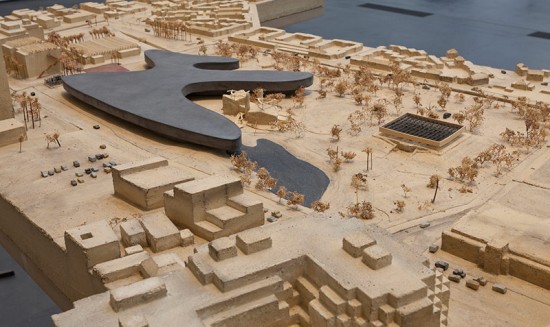
lacma_zumthor_01_550x327

Model of Zumthor design for LACMA. Image courtesy of Museum Associates.

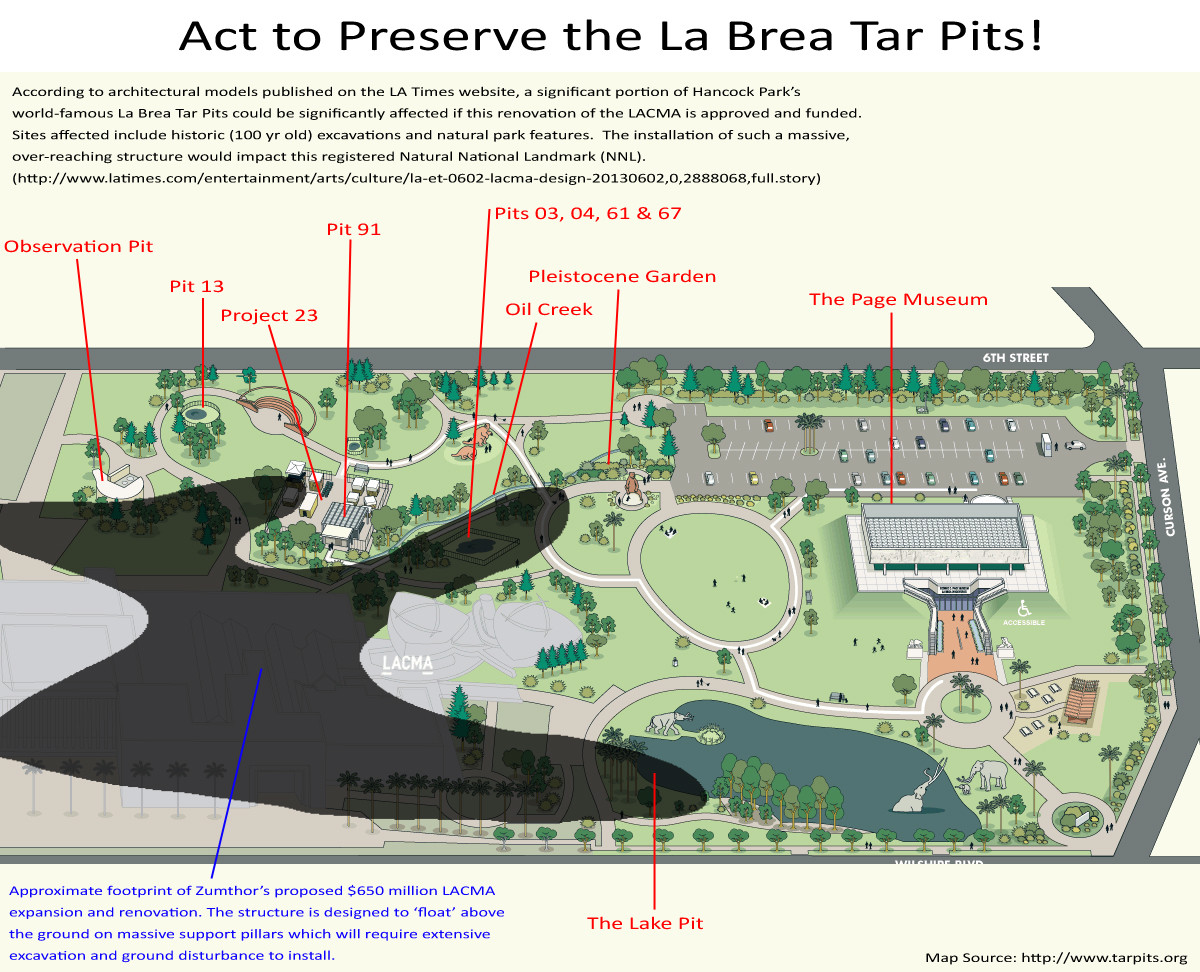
A lively debate has erupted on the potential impact of the Peter Zumthor re-design of the Los Angeles County Museum of Art campus. On September 24 representatives of the Page Museum and LACMA appeared before the Los Angeles County Board of Supervisors to address concerns that the sprawling Zumthor building could severely affect the La Brea Tar Pits.

The Miracle Mile Residential Association [MMRA], too, is concerned that LACMA’s plans will not only have an adverse impact on the tar pits but also reduce green space at Hancock Park. At the August 29, 2013 MMRA Board of Director’s meeting a motion was adopted opposing LACMA’s expansion into Hancock Park.

Since its arrival in the early 1960s, LACMA has been steadily encroaching on Hancock Park – the largest public park in the Miracle Mile. The park’s green space provides a sense of well-being to our community and enhances our quality of life. It is where our residents go for an impromptu picnic, to jog, take a leisurely stroll, or to teach their child how to ride a bike.

But LACMA tends to view the park as their backyard. This attitude is evident in the expanding footprint of the new design for the museum – which boldly ignores several County Board of Supervisor’s resolutions limiting LACMA to 6 acres of the original 23-acre park.

The Miracle Mile is one of the most densely populated areas in Los Angeles. Since 2005 over 1200 new apartments have been constructed along Wilshire Boulevard corridor between La Brea Avenue and Fairfax Avenue – and many more are under construction or in the planning stages. The advent of the Purple Line subway extension will bring large Transit-Oriented-Density mixed-use buildings at both the La Brea Avenue and Orange Grove Avenue subway portals – and add thousands of new residents to the Miracle Mile.

Los Angeles lags all the major cities in California in parks per capita and ranks 17th among major U.S. cities. The paucity of parkland in Los Angeles and the ever-increasing population of the Miracle Mile emphasizes the critical importance of the Hancock Park to our community.

Hancock Park is a Swiss Army knife, so to speak – a multi-functional tool. It is most notable for being the site of the La Brea Tar Pits, the largest repository of Ice Age fossils in the world. It is also the home of the Page Museum, LACMA, and the soon-to-be Academy Museum – which will draw an additional one million visitors a year and create yet another strain on the park grounds.

The proposed Zumthor design consists of a single floor building – the approximate size of two football fields – floating thirty feet above grade. This encroachment into the park would upset the delicate balance of Hancock Park by overwhelming its original purpose to preserve and promote the history of the La Brea Tar Pits and, by reducing its green space, demoting its critical function as a public park.

Wealthy oilman G. Allan Hancock gave the land to Los Angeles County to “protect and preserve the La Brea Tar Pits.” The 1924 deed specified that the donation was “for Public Park purposes.”

When LACMA attempted to expand into Hancock Park in 1969 County Supervisor Kenneth Hahn introduced a motion – that was unanimously adopted – stating that: “The possibility of using more of the land for Art Museum facilities has been suggested. To do so would be a mistake. The park is one of the few public open spaces left in the area. Also, the Museum of Natural History is still exploring the tar pits for prehistoric material and it must be able to do this without fear of encroachment.”

History is repeating itself with LACMA’s new plans for expansion into Hancock Park, but the MMRA feels that what was true in 1969 is still true today: to do so would be a mistake.

LACMA Tar Pits overlay

A Very “Hesitant” Planning Commission Denies Appeal of Petersen Facade

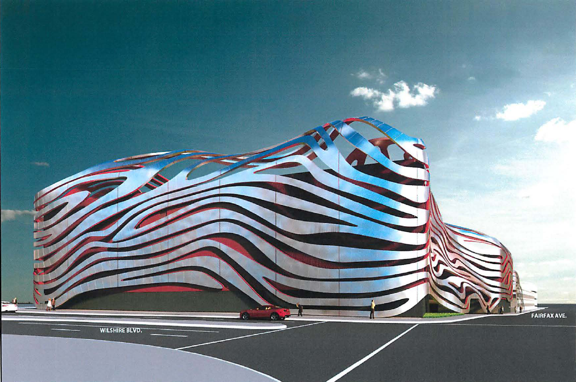
Petersen CDO Wilshire Elevation

The September 10, 2013 Central Area Planning Commission hearing on the appeal of the Planning Director’s approval of the new Petersen Automotive Museum facade had a cliff-hanging ending when two commissioners reluctantly joined the third commissioner and voted to uphold the approval and deny the appeal. Both Commissioner Chanchanit Martorell and Commissioner Samantha Millman – who were visibly uncomfortable when a dizzying set of motions and procedural maneuvers left them with no choice but to vote down the appeal – used the word “hesitant” in explaining their actions.

MMRA President James O’Sullivan filed the appeal on the grounds that the Petersen façade was a radical departure from the guidelines and standards of the Miracle Mile Community Design Overlay District [CDO]. The CDO was created to preserve the unique historical context of Miracle Mile and approved by the City Council in 2004.

A key objective of the CDO is to create a pedestrian friendly environment in the Miracle Mile. The Petersen Museum has never maintained a pedestrian entrance on Wilshire Boulevard and didn’t include one in the proposal they submitted to renovate their exterior – nor did their proposal even include a sign identifying the museum on the Wilshire side.

In his appeal O’Sullivan hammered the Petersen for continuing to turn their back to Museum Row and criticized the Planning Director for not mandating a Wilshire Boulevard entrance when he approved the façade. O’Sullivan’s point had obviously caused concern within the Planning Department that it would give the commission good cause to uphold the appeal because the lack of a Wilshire entrance and signage is a flagrant violation of the CDO. At the very beginning of the hearing planning staff indicated that – although they were recommending that the appeal by denied – they had additional conditions to add to the Director’s approval. Those conditions turned out to be that a Wilshire entrance and signage be stipulated.

The Petersen representatives maintained that the new façade was a “Twenty-First Century interpretation” of Art Deco and Streamline Moderne. This was rebuffed by Commissioner Martorell, “I am very familiar with Art Deco, I appreciate Art Deco, I am passionately in love with Art Deco . . . [This is] Not what I would personally consider Art Deco myself.”

In his presentation to the commission O’Sullivan pointed out that this was the first time in its thirty-year existence that the MMRA has filed an appeal. “We always find a way to compromise on projects,” he stated. “But the Petersen submitted this and got it approved by the City without any community outreach. We were kept in the dark.”

In a brief that O’Sullivan submitted he demonstrated how the Petersen and planning staff had cherry-picked their way though the CDO – stretching certain design guidelines and ignoring others to demonstrate compliance. At the hearing he warned the commission that if they upheld the Director’s Approval it would virtually nullify the CDO by establishing a precedence that would allow other developers and building owners to sue the City if they were forced to strictly comply with the CDO.

“It would have been better if the Petersen had asked for a complete exemption from the CDO or more honorable if they had asked the stakeholders to revise the CDO rather than to twist and torture it to get approval for their project,” said O’Sullivan. “This will cause irreparable harm to the CDO.”

Despite a roster of supporters endorsing the Petersen façade and the Director’s interpretation of the CDO – including a surprise appearance by Councilman Tom LaBonge, whose joviality trivialized the proceeding – everyone in the hearing room was caught by surprise when it came time for the vote.

Commissioner Young Kim introduced a motion denying O’Sullivan’s appeal and supporting the Director’s Approval with the additional conditions regarding the stipulation of a Wilshire entrance and signage – but it did not receive a second. That is when it became apparent that Commissioners Martorell and Millman had been receptive to O’Sullivan’s presentation and had reservations about the façade’s compatibility with the CDO.

Absent a second to the motion some confusion ensued. It was explained that without a second the motion would fail and the appeal would be automatically denied – and the original Director’s approval would stand, which did not stipulate a Wilshire entrance. So, Commissioner Kim re-introduced the motion. Finally, a soft-spoken Commissioner Millman offered: “A very hesitant second.”

When the vote was taken Millman and Kim voted in favor of the motion, but Commissioner Martorell [right] prefaced her vote with: “I have to say that I find the design somewhat problematic and . . . I think that there could be another design that’s more emblematic of this area, and I just have problems, so I just say no. I vote no.”

But then Martorell found herself painted in a procedural corner: the only way the commission could insure that the Petersen would have a Wilshire entrance and signage was to unanimously vote in favor of the motion.

“That [the lack of a Wilshire entrance] would be a loss to the community, irrespective of the design element. This is difficult. I don’t agree with this design,” Martorell said before changing her vote to affirm the motion and deny the appeal.

The MMRA Board of Directors, which endorsed and fully supported O’Sullivan’s appeal, is considering other options to preserve the integrity of the CDO.

MMRA Vice President Ken Hixon, who attending the appeal hearing, remarked, “Jim didn’t win the appeal, but he personally unlocked the Wilshire entrance to the Petersen Museum. That’s something we’ve been trying to do for the last 20 years.”

Appeal of Petersen Museum Facade Denied

MMRA Exploring Other Options…

On September 10, 2013 the Central Area Planning Commission denied an appeal filed by James O’Sullivan, President of the Miracle Mile Residential Association [MMRA], regarding the new facade for the Petersen Automotive Museum. The three-member Commission voted to sustain the Director’s determination for a Community Overlay Approval of the facade.

O’Sullivan filed an appeal on grounds that the new facade would violate the guidelines of the Miracle Mile Community Design Overlay District [CDO], which was approved by the Los Angeles City Council in 2004 to provide design standards for public and private development in commercial zoned areas along Wilshire Boulevard. O’Sullivan’s appeal was endorsed by the MMRA Board of Directors, who share his concern that approval of the Petersen facade will set a precedence that will nullify the CDO. The MMRA is carefully exploring all available options in order to protect the CDO.

For additional information read:

MMRA President Appeals City’s Approval of Petersen Museum Facade, Miracle Mile Residential Association Newsletter, September 2013

A Perfect Storm

A Message from Jim O’Sullivan, President of the MMRA

The Miracle Mile Residential Association is beginning to analyze a number of upcoming development projects and some basic questions are already being asked. They deal with mobility and the perennial issue of traffic. While the Miracle Mile isn’t alone in traffic concerns, we certainly have far fewer options than many other areas to get in and out of our neighborhood.

A comment at one of the mayoral debates caught my attention – it was said that what Los Angeles needed was a tunnel under the Sepulveda Pass to connect the Westside to the Valley. My immediate thought was that the Miracle Mile needs a tunnel under Park La Brea, because it sits like a large man-made mountain just to our north, which effectively gives us only four north-south routes into and out of the Miracle Mile. Fairfax, Hauser, Curson and La Brea are the only streets that can get us to 3rd Street or Beverly Boulevard – where many of us go to purchase a number of items we need to live our lives.

Frankly, if we had more retail services in the Miracle Mile this would not be as big a problem as it is. Wilshire Boulevard is designated by the City as a “Regional Center” – which means it serves as a focal point of regional commerce, identity, and activity for a population of 250,000 to 500,000 persons. In the Miracle Mile we have the corporate and professional offices, the restaurants, and the entertainment and cultural facilities that regional centers are supposed to have, but we are severely lacking in retail stores – which is one of the main reasons why so many of us are in our cars trying to get in and out of the neighborhood. The so-called “mixed-use” projects recently constructed aren’t particularly “mixed” – they have provided hundreds of new apartments and a dozen-or-so new restaurants but that’s pretty much it. We did get a cash-for-gold outfit and a bank branch, but no clothing, furniture, or other retail stores. If you need a pair of jeans or a coffee table you’re not going to find it on the Miracle Mile.

Once upon a time we had the May Company at the corner of Fairfax and Wilshire where I could get most everything I now have to travel to the Grove or the Beverly Center to get. (The May Company tearoom also had great Cobb salads, which I still miss.) In its place we will get the Academy Museum that I’m sure will be incredible – but it will add an extra 800,000 visitors a year to the 1.2 million visitors that LACMA already attracts. On the drawing board at Wilshire and Curson is a quarter of a million square feet of office space with 300-plus residential units to be added to the 1,200-plus units already built in the Miracle Mile in the last eight years.

The City of Los Angeles is about to undertake an Environmental Impact Report for the Mobility Element Update of the General Plan. It’s the old Circulation Element, which deals with everything that moves. Part of that update requires the City to comply with the state mandated “Complete Streets Act” which will fundamentally change how we use our streets. We have to make them accessible and safe for pedestrians, bicycles, autos and the movement of goods. Given that LA is once again the number one most congested city in the United State that will be a real challenge because some of the plans call for removing traffic lanes from service to facilitate certain mobility goals (i.e., bike lanes). Meanwhile, Metro will start construction of the Bus Rapid Transit project along Wilshire this summer which will divert as much as 30% of rush hour traffic onto 6th and 8th streets and the L.A. Department of Transportation and other forces seem eager to snatch traffic lanes from 6th Street for bike lanes.

It is a perfect storm: unchecked development and utopian transportation schemes colliding into each other and rendering our community paralyzed. Advocates and planners tout high density and bike lanes as the one-size-fits-all solution for all that ails Los Angeles. But the residents of the Miracle Mile want specific solutions to their specific problems. We don’t oppose innovation or change, but there are practical things that were working for us – like the DASH bus system that has seen its budget and service slashed. And if the City wants to talk about mobility, how about they fix the sidewalks first? Why isn’t repaving Wilshire or La Brea a priority to all these whiz-kid urban planners?

The Miracle Mile Residential Association is prepared to participate in any and all efforts to keep our streets and sidewalks usable, livable and safe. But we will not surrender our common sense to achieve these goals. We will ask hard questions and demand answers that our grounded in reality. Pie in the sky isn’t on our menu.

[from the May 2013 edition of the Miracle Mile Residential Association Newsletter]

Gone Hollywood; How the Hollywood Plan Threatens the Miracle Mile

A Message from Jim O’Sullivan, President of the MMRA:

Like many of you, we lost power at my house during the two wind events last week. I say “wind event” rather than wind storm because occasional wind gusts do not equate to a full-fledged storm. I have no idea what exactly caused these particular power outages ­– but I’m sure it has something to do with our aging and neglected infrastructure in Los Angeles. Our sidewalks are being buckled by untrimmed trees, our streets are an obstacle course of potholes, our aging water mains have become time bombs, hit and run accidents go uninvestigated for lack of properly trained traffic investigators, and budget cuts have slowed the response times of paramedics – the critical systems that support the quality of our lives are in a free fall.

Why would those of us who don’t live in Hollywood get involved in criticizing and/or opposing the recent update of the Hollywood Community Plan? The answer is: infrastructure. Because what happens in Hollywood doesn’t stay in Hollywood. Mayor Villaraigosa calls the super-sized developments recently proposed for Hollywood “elegant density,” but the residents call the plan the “Mahattanization” of Hollywood and find very little elegance in a plan that calls for adding an additional 50,000 residents without addressing the strain it will impose on the already collapsing infrastructure.

The new Hollywood Community Plan does not allocate funds to pay for fire and police services, water main and sewer maintenance, street and sidewalk repair, tree trimming, and the like. The City will have to borrow from Peter to maintain Paul, so to speak. In lieu of sensible long-term budgeting and planning the City will continue to deal with our infrastructure needs on a crisis basis: deferring routine maintenance and repairs in the Miracle Mile and every other community in Los Angeles to deal with the problems of the hour.

High-density-mixed-use-development-along-mass-transit-corridors is the new mantra of city planners and private developers. Build it big, the bigger the better; don’t sweat the details, it will work out somehow. The residents in the Miracle Mile are all for development, more jobs, reduced carbon footprints, subway extensions, and bike lanes, too – but we also like good old fashioned infrastructure. Infrastructure is the foundation of our city and it is folly to renovate, remodel, or expand a structure with a sinking foundation.

Like Hollywood Boulevard, Wilshire Boulevard is a mass transit corridor. In the years to come, the Miracle Mile will have two subway stations and the city planners and private developers already have visions of yet another Manhattan dancing in their eyes. They will want to do to the Miracle Mile what they are doing to Hollywood and, once again, they don’t seem inclined to let the lack of funding for proper infrastructure impede their goals.

Many of us love the real Manhattan (I do), but the real thing has a public transit system that actually takes you where you want to go and its famous density is a result of being an island. Manhattan is also a very expensive city with an ever-shrinking middle class being squeezed out by the high cost of living. Development and gentrification in Hollywood has already driven away thousands of working class Latino families. (LA Weekly; Hollywood’s Urban Cleansing.)

All this brings me back to the so-called “wind events” which seem to constantly knock out our power in the Miracle Mile. Councilman LaBonge has told me he will find out what happened and I know he will, but that won’t solve a basic question I have, which is: Where does all the money go?

Los Angeles has a $7 billion budget (which doesn’t include the Department of Water and Power, LAX, or the Port of L.A.), so what are they spending that $7 billion on and why do they keep wanting to increase our fees and taxes? Something very wrong is going on here and before the City turns Los Angeles into Manhattan they need to explain how they are going to fix our infrastructure – or, in other words, how they will keep the lights on at my house.

 – from the March 2013 edition of the Miracle Mile Residential Association Newsletter

MMRA Position on Bike Lanes on 6th Street:

Save Our Parking!

Preferential Parking District 78
Threatened with Elimination of 6th Street Parking

In July 2012 a tragic accident occurred at the intersection of 6th Street and Hauser Boulevard. A vehicle traveling westbound on 6th Street collided with a eastbound vehicle attempting to make a left-hand turn onto Hauser. The collision forced the westbound vehicle off the road and into a pedestrian, a 74-year-old-woman, who died as a result of her injuries. The intersection of 6th and Hauser has a long history of being one of the most dangerous in our neighborhood. We commend Council Member LaBonge’s quick action in introducing a motion calling for the Department of Transportation to make recommendations for implementing traffic calming measures at 6th and Hauser in order to address safety issues. The motion was referred to the council’s transportation committee which passed the resolution and the city council followed suit on August 15th, 2012.

The MMRA fully supports traffic calming measures, but in the same motion Council Member LaBonge also requested that the Department of Transportation consider adding dedicated bike lanes on 6th Street that would cause the loss of a traffic lane in each direction as well as the elimination of preferential parking spaces. Preferential Parking District 78, like most of the Miracle Mile, includes many older apartment buildings with scarce or no off-street parking. Eliminating permitted parking on 6th Street will make an already bad parking situation much worse. It will force residents to seek parking spots on adjacent blocks creating a domino effect that would adversely impact on-street parking throughout the Miracle Mile.

Installing bike lanes on such a heavily trafficked street defies common sense. There are other less congested streets in the Miracle Mile that are better suited for bike lanes – streets that would be far safer for cyclists. Losing two traffic lanes on 6th will doubly impact the Miracle Mile when the Bus Rapid Transit [BRT] rush hour–bus only curb lane restrictions go into effect. The city estimates that BRT will divert 30% of Wilshire Boulevard traffic onto 3rd, 6th and 8th streets. Removing two lanes from 6th will clog our neighborhood with commuters searching for alternate routes.

The Miracle Mile Residential Association opposes bike lanes on 6th Street. We believe there are practical solutions to calm traffic on 6th Street that will preserve valuable on-street parking.

from the February 2013 edition of the Miracle Mile Residential Association Newsletter

2010 Annual Meeting – November 6, 2010

Please join us for the Miracle Mile Residential Association 2010 Annual meeting. We will be celebrating 27 Years of Service to the Miracle Mile.

Continue reading “2010 Annual Meeting – November 6, 2010”