
Miracle Mile Spotlight: Urban Florist
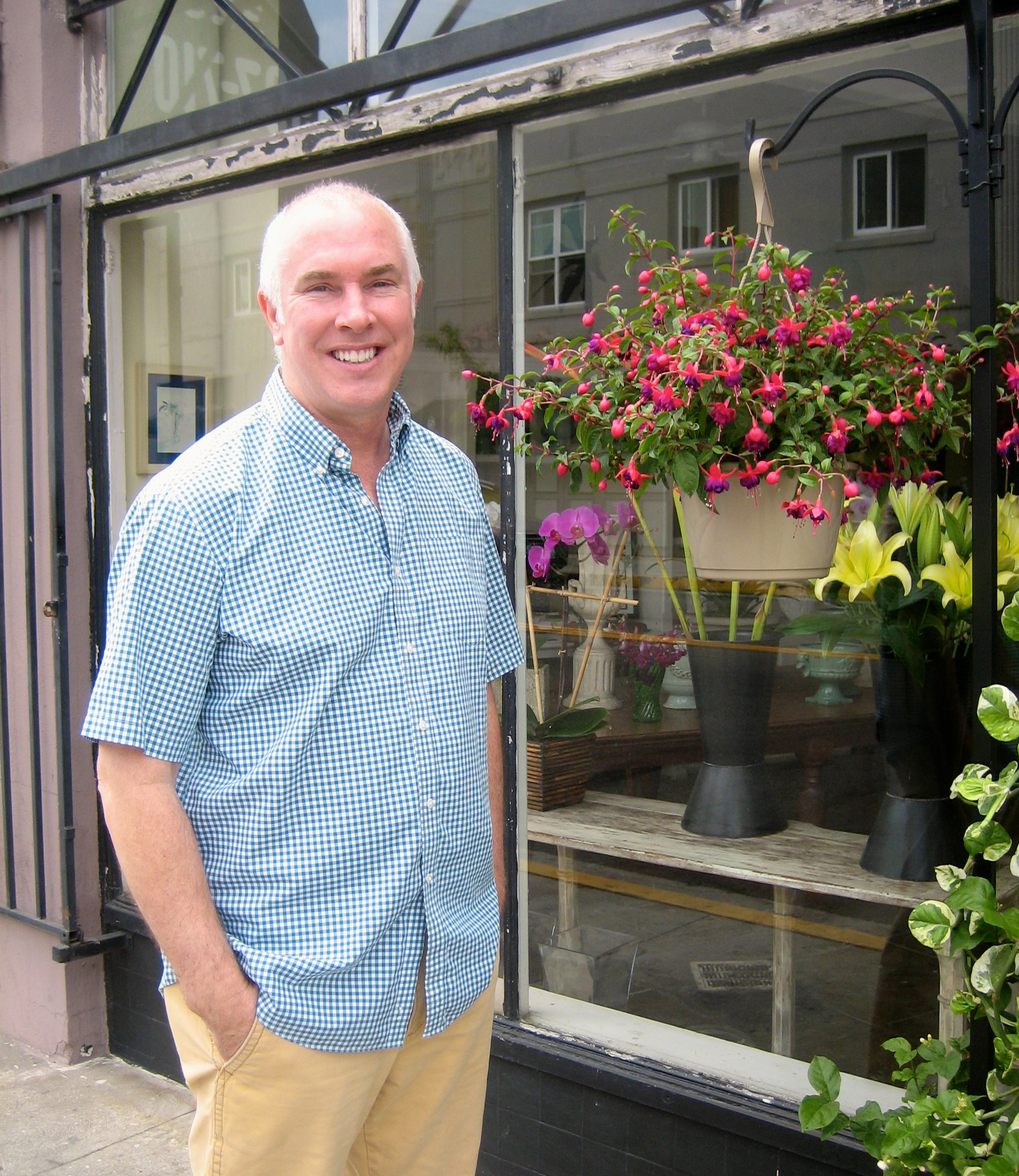
Bryan Brayton [photo above] is very much a Connecticut Yankee in the Miracle Mile. He’s an even-tempered, friendly, and contented man. He opened his florist shop on the south side of 8th Street, just a short distance from La Brea Avenue, in 1986. Urban Florist is one of the oldest small businesses in the Miracle Mile, despite a less than promising start:
“I remember the first day I opened, my family came and we pulled up to the shop and the whole front was spray painted with graffiti,” Bryan laughs at the memory. “We were from a little country town in Connecticut and my father said, ‘What kind of neighborhood is this?’”
But the Miracle Mile suited Bryan. He discovered the area when he came west on vacation and decided to stay. Flowers have always been his passion. Back east he had studied floriculture, design, and the business aspects of the trade. So, he found work at a florist shop on Doheny. After three years there, he decided he could run a shop on his own and, with a loan from his father, Urban Florist opened for business.
At the beginning he was a one man enterprise: “I would answer the phone, make the arrangement, turn on the answering machine, get in the car, go deliver it, come back, get the messages, call the customers back…” He shakes his head and chuckles.
Now he has two employees: a designer and delivery driver. Although, he temporarily increases his staff to meet the demand on Mother’s Day and Valentine Day.
One of the things Bryan enjoys most about his profession is going downtown to the flower mart three mornings a week. He typically arrives there at 5 AM, although the wholesale market opens at 2 AM. “It’s a whole other world,” he says. “It’s lucky I was born a morning person.”
The florist business has changed since he first opened his establishment. “Thirty years ago people went to florist shops to buy flowers. Now they go to Ralph’s and Trader Joe’s. There used to be all these ‘bucket shops’ with rows and rows of flowers and that’s where you went to buy your flowers. But now Costco does weddings and once that happened all the bucket shops disappeared.” Fortunately, 90% of his business comes from internet orders or over the phone.
The shop is open six days a week. “You’re almost married to the business,” he states. “I do this more than I do anything else. And I like it. I haven’t had a summer vacation in ten years or more. But I’m very lucky. I grew up with a dad who said, ‘Kids, if you’re going to do something, make sure you like it,’ because he wasn’t happy with his corporate job with General Electric. He said, ‘Be happy with what you do, because you’re going to be at work more than you’re going to be at home.’”
Local customers respond positively to the fact that the shop is not a cookie-cutter franchise design. “People walk in and say, ‘this is so quaint, what a sweet little shop.’ You can almost hear them take a sigh of relief.”
“Fortunately, for me, all these new apartments buildings going up in the Miracle Mile are going to help a lot.” He’s been contracted to provide weekly flower arrangements for the leasing office and community spaces in the new mixed-use apartment building on the southeast corner of Wilshire and La Brea. “And, of course, Park La Brea has always been good for me. We do a lot of deliveries there.”
At this point in the interview, a delivery of small potted succulents was made, which prompted Bryan to remark: “At the end of the school year the moms order thank you gifts for their kid’s teachers. It’s another great part of being a little neighborhood florist: I get to see the circle of life. I’m on the second generation now. I’ve done kid’s proms, weddings, and now they’re having babies. I love it. It makes me feel small town. How wonderful to have people walk by every day and stick their head in the door and say, ‘Good morning, Bryan.’”
But the flip side of being in business of celebration is accommodating those who are in mourning. “I can’t tell you how many folks who were my original customers and their families will call me to say that they have passed away. It can be very upsetting. I’ve known them for years and all of a sudden they’re gone. I’m very attached to this neighborhood, there are some great people here.”
Urban Florist
5310 W. 8th Street
Los Angeles, CA 90036
Hours:
Monday–Friday: 9 AM–5 PM
Saturday: 9 AM–2PM
Closed Sunday
Phone: 323-937-7100
Fax: 323-937-0774
Email: UrbanFlorist@sbcglobal.net
Website: urbanflorist.net
The MMRA newsletter does not solicit or accept advertisements. Our support of local businesses is a matter of principle – for which we receive no financial compensation or consideration of any kind.

 Although the store has a website, she doesn’t sell online. “You don’t get the same community feeling if you don’t go into a store once in awhile – especially with toys. When you’re online buying toys you’re seeing an abstract of what everybody likes, you’re going to see the things that everybody buys. You can sort by most popular, best reviewed, but you’re not necessarily going to find little gems. Or something that might have gotten slammed in a couple of reviews but happens be a really fine product.”
 When asked about the impact of the impending subway construction on small businesses along Wilshire, Christine was blunt: “That is going to be chaos. It’s going to be dirty, noisy, messy. They [Metro] can definitely communicate better with businesses and residents. They’re not doing well with that at all. Nobody really knows what’s happening or when. I can’t plan my business if they’re not giving me any more details. But I came into it knowing all this. I opened the business knowing that Metro was coming. That’s why I picked this spot. And I knew it was going to be hell – for nine years, potentially. And I’ve never been naïve about the challenges.”
 Christine [photo, right] is optimistic that others like her will take the plunge and start new businesses in the Miracle Mile. “I have customers who come in – and it’s inspiring, I guess, for them to see a new business like this. They have their own dreams about their own business and they ask me all kinds of questions: how did you do it, how do you manage it, how do you do it with three kids? Starting a business for some people seems absolutely daunting. It is emotionally daunting. But if you can get past the emotional aspect of it, it’s a nine-to-five job –okay, maybe it’s eight to midnight.”
 “A huge part of that is staff,” answers Rebecca. “Our philosophy is that we hire for personalities more than experience. We want interesting people, people that travel and are educated – and have all those things going for them.”
 They are optimistic that they might be able to get out of town since the arrival of Chef Andy Lee [photo right], who joined them last October. His culinary skills and knack for organization are key ingredients in the restaurant’s continuing success. Chef Lee is enthusiastic about the advantages of creating dishes for a 50-seat establishment. “For me it’s my dream job,” he says. “I get to touch everything, see everything, and the feedback from the customer is immediate.”
 Sunday “Game Nights” have become a fun attraction for families – you can dine while playing your favorite board games and card games. “That is what makes this so neighborhood,” remarked Chef Lee. “You’re not going to see that at other big restaurants.”


 Since the passage of the BMO in 2008, 58 out of 690 single-family homes in the Beverly Grove area have either been demolished or remodeled in a manner that was out of scale and character with the neighborhood [photo right]. Fifth District Councilman Paul Kortez,
  Levy explained that the first step in becoming a historic district is to establish the boundaries of the proposed area. An HPOZ adds historic development standards strictly dealing with design to the existing zoning regulations, whether it be a single family, multiple family, or commercial zone. These standards require that any alteration to the façade of a historic property would be subject to review for conformance with the adopted preservation plan. The preservation plan is developed by the community to establish the guidelines for how properties within its boundaries can be altered and/or developed. The overall goal of an HPOZ is to preserve historic buildings and prevent mansionization and other new development that is incompatible with the surrounding properties.


 LEGEND


 Miracle Mile Residential Association