
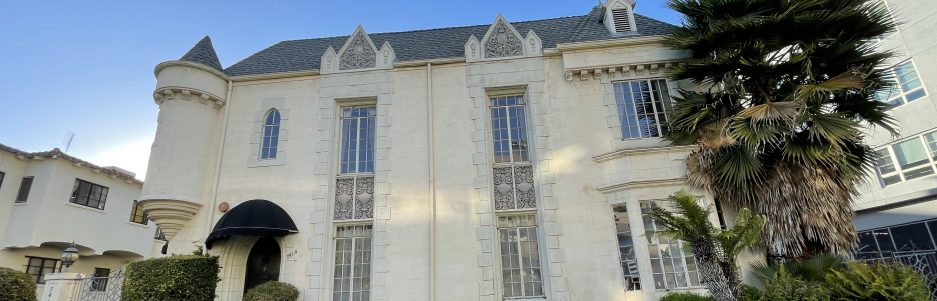

Proposed Ban on Single Family Home
Demolitions Includes Miracle Mile
A tidal wave of complaints about mansionization – and the inability of the existing Baseline Mansionization Ordinance [BMO] to stop the spread of McMansions – has prompted the City Council to propose a stopgap measure to protect neighborhoods under attack. A plan presented October 7th at the City Council’s Planning and Land Use Management Committee would impose temporary restrictions to stop or limit demolitions in areas with pending applications for either a Reduced Floor Area District [RFA] or Historic Protection Overlay Zone [HPOZ].
The Miracle Mile Residential Association submitted a request to create a RFA to Councilmember Tom LaBonge on September 13th. LaBonge appeared at the City Council committee to place the Miracle Mile on the list of neighborhoods to be included in the proposed Interim Control Ordinance [ICO].
The ICO – which is still to be finalized before being brought to a vote of the full City Council – would prohibit all single-family home demolitions while allowing only interior remodels that retain all exterior walls and roofs orfeature a less restrictive option that could allow complete demolitions but limit new structures to 120% of the size of the previously legally existing structure. Either measure would effectively stop mansionization, but MMRA President James O’Sullivan and Vice President Ken Hixon informed the committee that the MMRA preferred the first option prohibiting single-family home demolitions entirely.
 Nearby areas to be included on the list of protected neighborhoods are La Brea-Hancock and North Beverly Grove, which – like the Miracle Mile – are seeking RFA status, and Carthay Square, which has been waiting nearly four years for approval of its HPOZ. Staffing cuts to the Department of City Planning have created a logjam of pending RFAs and HPOZs. Developers have been exploiting this backlog to quickly build McMansions before protections are officially implemented.
An ICO is a temporary ordinance that is renewable in six-month increments for up to two years. It would stop mansionization in the most vulnerable areas and give the city time to reform the BMO and tighten zoning rules so that neighborhoods could have more say about the density and scale of new home construction and remodeling.
The ICO would protect the Miracle Mile while our RFA is developed and HPOZ protection is pursued. The proposed ICO clearly has the support of the entire City Council and it is anticipated that it will be approved and implemented by the end of the year.
For additional information:
Los Angeles Times: Tighter L.A. ‘Mansionization’ Rules Coming Too Slowly, Critics Say
MMRA Request for Reduced Floor Area District, Sept. 13, 2014
MMRA Newsletter, September 2014: MMRA Pursues “Reduced Floor Area District” for R-1 Zoned Properties in Miracle Mile”
Los Angeles Times [Editorial]: L.A. is Bogged Down in Trying to Save Its Historic Structures
Los Angeles Times [Steve Lopez]: L.A. Should Act Quickly to Close Loopholes in Mansionization Ordinance


 …In August 2011, Moody’s Investors Service downgraded LACMA’s bond rating and Museum Associates found themselves dog-paddling in the deep end of a financial mess of their own making. They needed an infusion of cash to stay afloat. Four months later, in October 2011, Museum Associates abandoned their promise to renovate the May Company for LACMA’s purposes and announced they had leased it to the Academy of Motion Picture Arts and Sciences [AMPAS] for an Academy Museum.
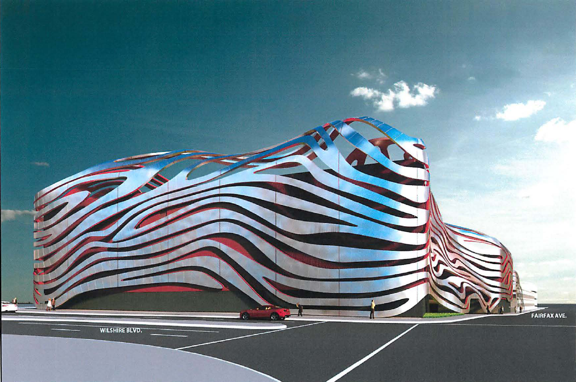
 But then, Museum Associates eloped with AMPAS and now what do we get? A third of the original May Company will be demolished to make way for a giant sphere that looks like it rolled here from Disney World in Orlando; a million visitors a year with no new on-site parking; gridlock; traffic and parking intrusions to our neighborhoods; a digital sign district; super graphics; searchlights; celebrity premieres on Fairfax Avenue; paparazzi; screaming fans; long lines of limos; midnight screenings; concerts; and numerous special events. And will most of these functions be open to the public? Not likely.
 [Photo courtesy of the Los Angeles Times.]


 So, they declared to the taxpayers that the planning department has the discretion to determine the manner by which the monitoring and reporting requirements of the general plan are done. That “not all plan policies can be achieved in any given action, and in relation to any decision, some goals may be more compelling than others. On a decision-by-decision basis, taking into consideration factual circumstances, it is up to decision makers to decide how best to implement theadopted policies of the general plan in any way which best serves the public health, safety and general welfare.”


 Miracle Mile Residential Association