MMRA Meets with Metro • Seeks to Shift Nighttime Utility Relocations to Daytime Hours


MMRA Meets with Metro

Seeks to Shift Nighttime Utility Relocations
to Daytime Hours

Miracle Mile Residential Association President James O’Sullivan and Vice President Ken Hixon met with representatives of Metro and the Los Angeles Department of Transportation [LADOT] on January 27, 2015 to discuss the noise and vibration impacts of ongoing nighttime utility relocation work.

At the meeting the MMRA presented a letter to Metro with suggestions for how nighttime noise disturbances could either be eliminated or better mitigated. The letter stated “It is clear after a year of Advanced Utility Relocations (AUR) that nighttime construction in the Miracle Mile – one of the most densely populated urban corridors in the country – cannot be done without disturbing the peace. Such work requires a super-human level of noise mitigation that has been demonstrated to be impractical to achieve on a consistent basis.”

The MMRA requested that LADOT grant Metro permission to work during morning and evening peak hours so that the majority of utility relocations could be shifted to daytime.

In a written reply, Kasey Shuda, Metro Construction Relations Manager, replied: “If the Los Angeles Department of Transportation was to approve peak hour exemptions for the project, from 6AM-9AM and 4PM-7PM, they would require two lanes of traffic remain open in each direction. This would cripple the ability of the contractor to complete a majority of AUR [advanced utility relocation] work due to the current condition of Wilshire Blvd. In order to keep two lanes of traffic open in each direction the project would be required to complete street reconfigurations including landscape removal, median demolition, signal relocation and street lighting relocations. These activities are not scheduled to take place until just prior to pile drilling. Pile drilling is the first activity of major subway construction. It is scheduled to take place first at the Wilshire/La Brea station in late 2015.”

The MMRA’s position is that since street reconfiguration is already in the plans to allow for the construction of the underground subway stations at La Brea and Fairfax, this reconfiguration should take place sooner than later to allow utility relocations to be done during daytime hours.

At the meeting Metro representatives acknowledged that it is nearly impossible to assure that nighttime construction won’t keep some residents awake, but that their goal was to disturb as few residents as possible. The MMRA takes issue with this calculation, which measures the success of mitigation by how many people are kept awake. We believe that every resident living along the Wilshire corridor has a fundamental right to sleep at night and that the only effective means to ensure this right is to stop subway construction between 11 PM and 7AM.


Click image to view video.

In its letter the MMRA also discussed proposed mitigations at the four subway construction sites to be located in the Miracle Mile. “Metro needs to go beyond mere compliance with the minimal requirements of the noise code if they want to generate good will in the community,” said Hixon. “Nine years of subway construction is going wear nerves thin, especially when nearby residents are kept awake all night.”

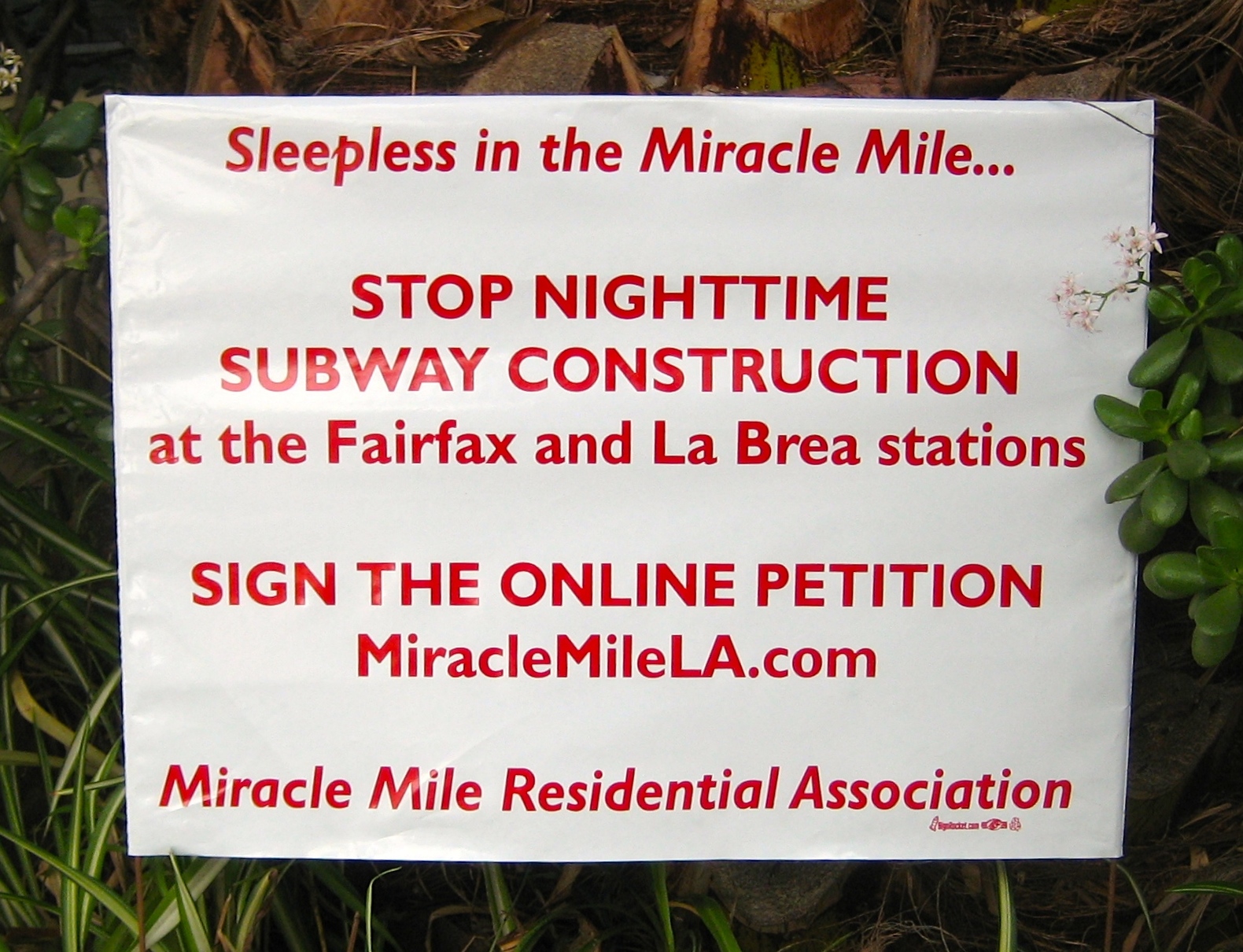
To date over 750 people have signed the “Sleepless in the Miracle Mile” petition opposing nighttime subway construction. The MMRA will continue to work with Metro and its contractors to make this lengthy project go as smoothly as possible, but we will not alter our opposition to nighttime construction. Nighttime subway construction and a good night’s sleep are inherently incompatible goals.

MMRA Letter to Metro, 27 Jan. 2015

Metro Letter to MMRA, 3 Feb. 2015

For additional information:

Park LaBrea News/Beverly Press: Noise from subway work rattles nerves at night

MMRA website: Subway Construction page

 

Angry Residents Confront Metro Officials at Noise Meeting

Subway Construction Update

Angry Residents Confront Metro Officials at Noise Mitigation Meeting

Grinder

On May 27, Metro held a meeting of the Purple Line Extension advisory group at the Petersen Museum. On the agenda was Metro’s mitigation plan for construction noise and vibration in the Miracle Mile. Metro’s PowerPoint presentation on the topic can be seen here.

The proposed mitigations offered to the community did not pass the “common sense” test with numerous residents in attendance. Nighttime work currently underway for utility relocations at Wilshire/La Brea and Wilshire/Fairfax sparked complaints from residents of the La Brea-Hancock area and from those living on Orange Street near Fairfax.

A mother of young children displayed a smartphone video she made of Metro contractors grinding welds on temporary steel plates covering a trench near La Brea and Wilshire; the late night work woke her children blocks away.

A professional recording engineer living on Orange Street argued that Metro was trying to snow residents by claiming that nighttime subway construction would not exceed nighttime ambient noise levels by more than 5 decibels. He pointed out that while that might seem to be only a slight increase in volume to the uninformed, in fact, a 5 decibel increase would nearly double the perceived nighttime ambient noise levels.

A Windsor Square resident complained that a long promised sound wall surrounding the subway construction yard at Crenshaw and Wilshire had yet to be completed – despite the fact that the utility relocation crews headquartered there began using the site many months ago.

Others inquired why nighttime utility relocation work recently detoured eastbound Wilshire traffic to 8th Street for two nights in a row; a situation that had idling and honking vehicles stacked up at the intersections of Genesee and Ogden late into the night – without traffic control officers present. Even Metro’s 720 bus was diverted to 8th, adding to the traffic noise that disturbed a number of nearby residents.

A Metro official admitted that they were having difficulty implementing practices designed to require the various utility relocation contractors to reduce nighttime noise; that it is a challenge for Metro to ensure that every construction vehicle has a low volume back-up alarm; and that, on occasion, a construction worker pulls up to the work site in the middle of the night with their car stereo blaring. This official was also unable to explain why workers were grinding welds at such a late hour, despite Metro’s often-repeated assurances that noisier work would be confined to the earlier hours of the evening.

The experiences of residents enduring the disturbances of nighttime utility relocations serves to reinforce the MMRA’s opposition to permit 24/7 activities at the Miracle Mile subway station construction sites. In their PowerPoint presentation Metro admitted that the greatest amount of noise would be generated at their Wilshire/La Brea yard, which will house a slurry recovery facility and a grout manufacturing plant – as well as serve as the location where all the dirt will be extracted from all of the tunneling from Western to La Cienega.

Once again, it was reiterated at the meeting that the contractor of the subway extension is solely responsible for mitigating noise and vibration. That the mitigations Metro touted at the meeting were only examples of mitigations that might be provided. This is why the Miracle Mile Residential Association maintains that until such time that Metro actually engages a contractor it is pointless to discuss specific noise mitigations for the subway construction sites at Fairfax and La Brea. Time and time again, the MMRA has informed Metro that it will not sign a blank check on work hours exemptions that will be cashed at the expense of the residents of the Miracle Mile.

The only way to guarantee that the neighborhood has a voice in how subway construction is conducted in the Miracle Mile is to sign the online petition opposing nighttime, Sunday, and holiday construction. This petition campaign, which has been underway since last February, has already compelled Metro to ask the Los Angeles Police Commission for a “time out” in considering their application for an exemption from work hours rules at the Miracle Mile subway construction sites.

Subway Petition Lawn Sign

The MMRA’s “no blank check” stance appears to have gained traction with the Police Commission. Recently, the commission began requiring all contractors seeking work hours exemptions in the Miracle Mile to consult with the MMRA before they will consider applications for variances. This is a requirement that the commission didn’t enact before they granted permission to allow nighttime utility relocation work. Obviously, our petition campaign has provoked this policy change and the MMRA is pleased that the commission is being so responsive and respectful towards our community.

The MMRA’s petition campaign has gotten a lot of attention – and some criticism from those who mistakenly believe that we oppose the subway extension. Our objective is to balance the fundamental right of thousands of residents to enjoy the peace and quiet of their own homes with the enormous demands of a massive, decade long, multiple billion-dollar construction project. Neither side is going to get everything they want, but the MMRA will not allow the needs of the residents to be ignored no matter how important or worthy the cause.

SIGN THE ONLINE PETITION

Click here to download the printable petition

We also invite you to visit the Subway Construction page on the MMRA website. It is frequently updated with links to media coverage on our petition campaign, official correspondence, construction fact sheets and reports, YouTube videos of subway construction techniques, and other information.

Petition Drive to Stop Nighttime Subway Construction Going Strong


Hundreds of Miracle Mile Residents Join the Fight
to Stop Nighttime Subway Construction

Last month the Miracle Mile Residential Association [MMRA] launched a petition drive to stop nighttime, Sunday and holiday construction for the Purple Line Subway Extension – which is scheduled to begin major work in August. In January 2014 the Los Angeles County Metropolitan Transit Authority [Metro] applied to the Los Angeles Police Commission to be exempted from municipal noise ordinances for subway construction in the Miracle Mile.

MMRA members and volunteers from the community have been distributing petitions every Saturday within the boundaries of the MMRA [see map]. So far about 60 % of the area has been canvassed and the remaining blocks should be completed by March 22. The response has far exceeded expectations and the online petition has proved to be a very effective means of collecting signatures.

The Police Commission has not set a date as to when they will render a decision on Metro’s applications to be exempted from noise ordinances, so the petition drive will be an on-going campaign until further notice. The petition effort has also received significant support from residents in neighborhoods adjacent to the Miracle Mile, who will be equally impacted by nighttime, Sunday and holiday construction. The MMRA has received a number of requests to expand the petition campaign beyond our boundaries and this be will taken this under serious consideration once the canvassing of the MMRA area is complete.

The petition campaign has attracted media attention and MMRA President James O’Sullivan and Vice President Ken Hixon have been interviewed by the Los Angeles Times for a story they are preparing about the impact of subway construction on the Miracle Mile. The Times also interviewed the owner of an apartment building located near the Fairfax subway station construction site, as well as a long-time resident on nearby South Orange Grove Avenue.

Metro is battling our efforts to stop around-the-clock construction by accusing the MMRA of being “against the subway.” This allegation could not be further from the truth. The MMRA whole-heartedly supports the extension of the Purple Line. Our issue with the subway expansion is solely about nine years of constant nighttime, Sunday and holiday construction noise and disturbances.

The Miracle Mile is one of the most densely populated urban corridors in the nation; we must stand together to remind Metro that we are a residential community and not a full-time construction zone.

CLICK HERE TO SIGN THE ONLINE PETITION

On March 3, 2014 the MMRA sent a letter to the Los Angeles Police Commission clarifying our position. The MMRA believes the burden should be on Metro to demonstrate why the residents of the Miracle Mile are unworthy of the protections of a well-established ordinance that protectsall residents of Los Angeles from 24/7 construction activities. We encourage you to read this letter; it makes a concise and strong argument why it is premature for Metro to seek to be exempted from the noise ordinance at this time [click here].

If you would like to help out with the petition campaign please contact us at: petition@MiracleMileLA.com.

Additional information:

MRA Newsletter – February 2014: MMRA Launches Petition Campaign to Stop Nighttime, Sunday, and Holiday Subway Construction at the Fairfax and La Brea Stations

The Subway Construction page on the MMRA website contains a lot of details and information with maps of the Fairfax and La Brea stations and construction staging sites. It also includes YouTube videos of tunnel boring machines in action.

MMRA Position on Subway Construction Work Hours Supported by Mid City West Community Council

Wilshire:La Brea Station map (Metro)

At the September 10, 2013 meeting of the Mid City West Community Council [MCWCC] a large majority of its board of directors voted against a motion granting Metro blanket exemptions from work hours rules and ordinances for the construction of the Purple Line subway extension in the Miracle Mile. The Los Angeles Police Commission issues work hours exemptions and Metro sought the endorsement of MCWCC in order to persuade the commission that all of the concerns of the residents of the Miracle Mile have been addressed – which is far from the case.

The Miracle Mile Residential Association [MMRA] opposes giving Metro a free pass on work hours rules that would allow them to engage in construction 24-hours-per-day/seven days a week, during rush hour traffic periods, and over the Thanksgiving and Christmas holidays. MMRA President James O’Sullivan and Vice President Ken Hixon attended the MCWCC board meeting and encouraged the board not to give Metro a blank check that would be cashed at the expense of the residents of the Miracle Mile.

As the site of two Wilshire subway portals at La Brea and Orange Grove and four construction staging sites extending well into densely populated residential areas the Miracle Mile will endure the full brunt of the subway extension project. Construction is estimated to take at least nine years. Given the immense scale of the work involved the disturbance and disruption to the surrounding community will be substantial.

The MMRA feels that it is premature for Metro to seek these exemptions now. Metro has yet to hire contractors for the La Brea and Orange Grove subway stations. These will be design-and-build arrangements where the contractors will be charged with both designing and constructing the stations. Hence, the reason why Metro has been so vague about how they will mitigate the disturbance of nighttime work and the traffic disruption of construction during rush hour periods – because all responsibility to mitigate the impact of subway construction rests solely on these yet-to-be-determined contractors.

The MMRA maintains that any exemption from work hours rules should be a dialogue between the residential and home owner associations directly impacted by subway construction and the contractors – not Metro. Only the contractors can provide the specific information necessary for well-reasoned decisions. The MMRA is willing to consider supporting limited work hours exemptions on a step-by-step basis for each major stage of construction. This would motivate contractors to do their very best to maintain good relationships with the community for fear that they would lose future chances at securing additional exemptions.

But at this time there are too many unanswered questions regarding the full impact of granting work hours exemptions, for example:

  • How will allowing construction during rush hour traffic periods impact the upcoming Wilshire Bus Rapid Transit [BRT] lanes – which reserve curb lanes during rush hour periods for buses only? Will it require that Wilshire be restricted to buses and all other traffic be diverted to 6th and 8th streets?
  • How will subway construction be coordinated with other construction projects in the Miracle Mile? The new Museum Square office building, the Academy Museum, the Desmond’s apartment complex, the proposed demolition of LACMA’s original buildings and the construction of the new museum, the new Shalhevet High School and adjacent mixed-use project will all be under construction during this time period. This extraordinary amount of activity could exponentially magnify the negative impacts of granting exemptions from work hours rules.
  • Museum attendance increases during the holiday season. How will an exemption permitting subway construction during the Thanksgiving and Christmas season affect Museum Row?

Having failed to secure the endorsement of MCWCC, Metro is currently seeking support for blanket work hours exemptions from the Greater Wilshire Neighborhood Council [GWNC]. La Brea Avenue marks the jurisdictional boundary between MCWCC and GWNC. Although the subway entrance and construction staging sites for the La Brea subway station are west of La Brea Avenue and part of MCWCC, a large part of the underground subway station extends east to into the GWNC area [see graphic at top].

O’Sullivan and Hixon appeared at the September 11, 2013 GWCC meeting to persuade its board not to grant Metro blanket work hours exemptions. The GWCC board referred the matter to their Transportation Committee for study. The MMRA will continue its effort to insure that the residents of the Miracle Mile have a full voice on how subway construction is conducted. We are optimistic that GWCC – like MCWCC – will support our position against granting Metro blanket work hours exemptions.