
MMRA Supports LaBonge Motion to
Reform Small Lot Subdivision Rules

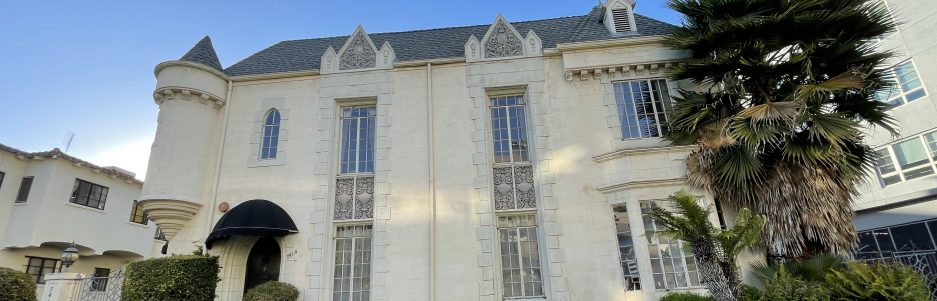
Example of typical small lot subdivision
In 2005, a “Small Lot Subdivision” amendment to the Los Angeles Municipal Code was passed allowing developers to carve up lots in commercial and multifamily residential zones into small single-family plots. The previous minimum size for a single-family lot of 5,000 square feet was reduced to 600 square feet with a minimum width of 16 feet. The purpose of this law was to promote housing density by permitting “infill projects” in established communities.
These smaller lots are fee-simple parcels that can be bought and sold independently of each other. Unlike condo owners, residents of the small-lot homes own a plot of land and a home that is built on a separate foundation. These “townhouses” do not share walls, although they are built only inches apart. Typically, these small-lot homes range from 1,000 to 2,000 square feet and are accessed via a long driveway on the edge of the property with two-car tandem garages at grade level, bedrooms on the next floor, an open-plan living area above that, and a rooftop deck.
The spread of small-lot home development – from Silver Lake to North Hollywood to Venice – is generating “push back” from nearby residents. Neighbors have complained about the noise generated by rooftop decks and the lack of parking when small-lot homeowners place multiple sets of trash bins on the street. Unlike many condo or apartment projects, small-lot guidelines do not require private trash pick up. Another problem is that the inherent inconvenience of tandem garages encourages small-home residents to use street parking. Also, these projects lack proper setbacks and their tall and boxy designs are often incompatible with the scale and look of the rest of the neighborhood.

Recently, Councilmember Tom LaBonge proposed updating current guidelines and imposing stricter rules on Small Lot Subdivisions as a result of the many complaints generated by these projects. LaBonge’s reforms would include a 15-foot setback for small-lot developments; require private trash pickup to eliminate having as many as 20 individual trash barrels on the street; replace tandem parking garages with traditional two-car garages; mandate additional review of rooftop decks to reduce impact on adjoining neighbors; and require that the architectural character of the neighborhood be considered in the approval process.
“I strongly believe in tweaking the Small Lot Subdivision ordinance to ensure that new small lot subdivisions fit into the character of the existing community better,” said LaBonge.
Although no small-lot subdivision projects have been built in the Miracle Mile – given the number of multifamily zoned properties in our community, some adjoining single-family homes – it is only a matter of time before this sort of development arrives. On October 9, 2014, the board of directors of Miracle Mile Residential Association endorsed Councilmember LaBonge’s effort to reform the Small Lot Subdivision rules. These changes would mitigate the most egregious problems created by these projects.
“Frankly, I don’t think this sort of development belongs in the Miracle Mile,” said MMRA President Jim O’Sullivan, “but there’s nothing we can do to stop it. But Tom LaBonge’s reforms are a step in the right direction by reducing their impact on the neighborhood.”
For additional information:
LaBonge Small Lot Subdivision Ordinance Reform Motion
The Eastsider L.A.: Councilman Calls for Reviewing Small-Lot Development Rules
Larchmont Buzz: Developer Plans Small Lot Subdivision for 421 Van Ness Ave.
Los Angeles Times: In Urban L.A., Developers are Building Trendy Homes on Tiny Lots

 Nearby areas to be included on the list of protected neighborhoods are La Brea-Hancock and North Beverly Grove, which – like the Miracle Mile – are seeking RFA status, and Carthay Square, which has been waiting nearly four years for approval of its HPOZ. Staffing cuts to the Department of City Planning have created a logjam of pending RFAs and HPOZs. Developers have been exploiting this backlog to quickly build McMansions before protections are officially implemented.


 …In August 2011, Moody’s Investors Service downgraded LACMA’s bond rating and Museum Associates found themselves dog-paddling in the deep end of a financial mess of their own making. They needed an infusion of cash to stay afloat. Four months later, in October 2011, Museum Associates abandoned their promise to renovate the May Company for LACMA’s purposes and announced they had leased it to the Academy of Motion Picture Arts and Sciences [AMPAS] for an Academy Museum.
 But then, Museum Associates eloped with AMPAS and now what do we get? A third of the original May Company will be demolished to make way for a giant sphere that looks like it rolled here from Disney World in Orlando; a million visitors a year with no new on-site parking; gridlock; traffic and parking intrusions to our neighborhoods; a digital sign district; super graphics; searchlights; celebrity premieres on Fairfax Avenue; paparazzi; screaming fans; long lines of limos; midnight screenings; concerts; and numerous special events. And will most of these functions be open to the public? Not likely.
 In the process of becoming a “digital” residential association we have witnessed first hand how good communication fosters engagement. It is in this spirit that the MMRA has decided to produce a series of video interviews with all of the candidates for Council District 4. Although traditional debates have their value, we want to provide an opportunity for voters to get to know each candidate in a “one on one” interview where their remarks are not hamstrung by the formal time constraints of a debate. This interview format will allow more “elbow room” for follow up questions and responses.
 [Photo courtesy of the Los Angeles Times.]


 So, they declared to the taxpayers that the planning department has the discretion to determine the manner by which the monitoring and reporting requirements of the general plan are done. That “not all plan policies can be achieved in any given action, and in relation to any decision, some goals may be more compelling than others. On a decision-by-decision basis, taking into consideration factual circumstances, it is up to decision makers to decide how best to implement theadopted policies of the general plan in any way which best serves the public health, safety and general welfare.”


 The hotel and condominium tower, presumably designed by Frank Gehry, would also have LACMA galleries, with a new architecture and design museum, as well as Gehry’s own archives. LACMA head Michael Govan told the Los Angeles Times, “I’m jealous that New York has a Gehry tower [left] and we don’t. My dream is some beautiful piece of architecture with an architecture and design museum at the base, which would add to Museum Row.” Never mind that much of Museum Row is being decimated in no small part owing to LACMA’s maneuvering the subway portal onto the very block where buildings housing the A+D Architecture and Design museum and two other private art galleries must now be demolished to make way for subway construction.
 While no one doubts that some kind of building will rise once Metro pulls its construction trailers and tunnel boring machinery off the site, LACMA’s ambition is as naked as it is vainglorious. A Frank Gehry skyscraper, looming directly across the street from LACMA’s main galleries, would be, like Trajan’s Column in Rome [right], a triumphal commemoration of the museum’s self-conceived importance not just in the surrounding neighborhood or city – but in the global marketplace of art.
 The William Pereira designed LACMA campus, circa 1965.
 And, so, the museum spent several years lobbying G. Allan Hancock [right], the wealthy oilman who’d given the county the park that bears his name and contains the La Brea Tar Pits. Repeatedly, they tried to convince him to cede a piece of the 23 acres for their art museum, although it had been Hancock’s express wish to build a “fossil museum” dedicated to displaying the park’s unique Ice Age finds. In 1959, Hancock finally relented, agreeing to give the art museum 7 acres, and no more. The moment the plans for the new museum were unveiled – the William Pereira designed complex that is now destined to be demolished – LACMA began its long effort to aggrandize pieces of the park.

 Homeowner and residential associations, as well as other community organizations, have recently increased the pressure on the City Council to fix the BMO so that RFAs would not be needed to stop mansionization. Having an ever-growing number of RFAs created throughout L.A. would strain the already threadbare resources of the Department of City Planning. Reforming the BMO would protect Los Angeles neighborhoods and save the taxpayers money.
 At its next meeting on September 4, 2014, the MMRA board will assess whether sufficient progress has been made by the City Council to reform the BMO. If – at that time – there is no evidence of movement towards substantial reform of the BMO, the MMRA will launch an outreach and petition campaign to create the Miracle Mile Reduced Floor Area District. The MMRA would pursue the same regulations contained within the Beverly Grove RFA, which was instituted in October 2013. [
 Although the committee’s work is in the preliminary stages, it is already apparent that an HPOZ is the only means available to ensure the historic continuity, appearance, and scale of our community. An HPOZ would help to level the playing field that is heavily weighted in favor of real estate speculators and developers – and the politicians who depend on their campaign contributions.
 Miracle Mile Residential Association