Proposed Ban on Single Family Home Demolitions Includes Miracle Mile


Proposed Ban on Single Family Home
Demolitions Includes Miracle Mile

A tidal wave of complaints about mansionization – and the inability of the existing Baseline Mansionization Ordinance [BMO] to stop the spread of McMansions – has prompted the City Council to propose a stopgap measure to protect neighborhoods under attack. A plan presented October 7th at the City Council’s Planning and Land Use Management Committee would impose temporary restrictions to stop or limit demolitions in areas with pending applications for either a Reduced Floor Area District [RFA] or Historic Protection Overlay Zone [HPOZ].

The Miracle Mile Residential Association submitted a request to create a RFA to Councilmember Tom LaBonge on September 13th. LaBonge appeared at the City Council committee to place the Miracle Mile on the list of neighborhoods to be included in the proposed Interim Control Ordinance [ICO].

The ICO – which is still to be finalized before being brought to a vote of the full City Council – would prohibit all single-family home demolitions while allowing only interior remodels that retain all exterior walls and roofs orfeature a less restrictive option that could allow complete demolitions but limit new structures to 120% of the size of the previously legally existing structure. Either measure would effectively stop mansionization, but MMRA President James O’Sullivan and Vice President Ken Hixon informed the committee that the MMRA preferred the first option prohibiting single-family home demolitions entirely.

Nearby areas to be included on the list of protected neighborhoods are La Brea-Hancock and North Beverly Grove, which – like the Miracle Mile – are seeking RFA status, and Carthay Square, which has been waiting nearly four years for approval of its HPOZ. Staffing cuts to the Department of City Planning have created a logjam of pending RFAs and HPOZs. Developers have been exploiting this backlog to quickly build McMansions before protections are officially implemented.

An ICO is a temporary ordinance that is renewable in six-month increments for up to two years. It would stop mansionization in the most vulnerable areas and give the city time to reform the BMO and tighten zoning rules so that neighborhoods could have more say about the density and scale of new home construction and remodeling.

The ICO would protect the Miracle Mile while our RFA is developed and HPOZ protection is pursued. The proposed ICO clearly has the support of the entire City Council and it is anticipated that it will be approved and implemented by the end of the year.

For additional information:

Los Angeles Times: Tighter L.A. ‘Mansionization’ Rules Coming Too Slowly, Critics Say

MMRA Request for Reduced Floor Area District, Sept. 13, 2014

MMRA Newsletter, September 2014: MMRA Pursues “Reduced Floor Area District” for R-1 Zoned Properties in Miracle Mile”

Los Angeles Times [Editorial]: L.A. is Bogged Down in Trying to Save Its Historic Structures

Los Angeles Times [Steve Lopez]: L.A. Should Act Quickly to Close Loopholes in Mansionization Ordinance

MMRA Submits Comments on Academy Museum DEIR

MMRA Submits Comments
on Academy Museum DEIR


The Miracle Mile Residential Association [MMRA] has submitted its comments on the Draft Environmental Impact Report [DEIR] for the proposed Academy Museum at the former May Company site. The nearly 7,000-page DEIR was released on August 28, 2014. The 45-day commentary period closed on October 14, 2014.

The DEIR highlights the scale of the Academy Museum project:

  • The creation of a “Sign District” allowing for the historic May Company building to serve as a background for super-graphics and digital signs.
  • Demolition of the 1946 northern addition of the May Company building to allow for the construction of the 1000-seat “Sphere” theater with a 10,000 square foot enclosed view deck. In total, the overall project will house three theaters with a combined seating capacity of 1,350 persons.
  • A ground level “Piazza” beneath the “Sphere” theatre providing access to the northern entrance to the Academy Museum. The “Piazza” would host outdoor events and screenings with up to 2,500 attendees.
  • Banquet and conference space with a capacity for 1,200 persons, including a “ Tearoom” rooftop terrace with a capacity of 800 persons that will also be utilized for outdoor film screenings.
  • A Museum Café with seating for 150 persons and a 5,000 square foot Museum Store.
  • A projection of 860,000 visitors per year with no new on-site parking.
  • Movies premieres, concerts, and other special events.

The DEIR is a very lengthy and complex legal and technical document that is difficult to concisely summarize. (For an in-depth view, follow the links below to see the MMRA’s comments to the DEIR and our independent traffic expert’s assessment.) The MMRA objections to the project center on traffic congestion, traffic and parking intrusions, infrastructure, public services, and the overall impact of locating a major special events center in a heavily congested and densely populated residential area.

Here’s the backstory.  In the mid-2000s the Academy of Motion Picture Arts and Sciences [AMPAS] began aggressively acquiring parcels in Hollywood as a future location for a museum. Working with the now defunct Los Angeles Community Redevelopment Agency, which wielded its power of eminent domain, AMPAS secured a full city block south of Sunset Boulevard on Vine Street. Including other parcels, as well as their holdings at the adjacent Pickford Center of Motion Picture Study, AMPAS assembled approximately 8 acres.

Then, with the stock market crash in 2008 and ensuing recession, AMPAS’s fundraising campaign for the Hollywood museum site derailed. They were left holding a large parcel that was suddenly worth much less than they had paid.

Three years later the dream of an Academy museum was revived. In 2011 AMPAS signed a long-term lease to take over the former May Company from Museum Associates, which operates the Los Angeles County Museum of Art [LACMA].

This preamble about AMPAS’s thwarted plan to locate a museum in Hollywood is relevant because it spotlights what is so obviously wrong with their plan to locate the Academy Museum in the Miracle Mile: They are trying to fit all of their grand plans for an 8-acre project in Hollywood into a mere 2.2 acres at the May Company site.  It is not an easy fit.

AMPAS has had to resort to slight-of-hand in the DEIR to create the illusion that an Academy Museum is compatible with the Miracle Mile – so that they can preserve their objective to be a major tourist attraction and special events center. But the only way they can do that is to minimize its true impact on the community.

A 2008 Traffic Study for the proposed Hollywood museum location projected 7,800 visitors per day. The DEIR for the May Company location projects only 5,000 – for a total of 860,000 visitors per year. Museum experts not connected to AMPAS predict that the project will easily draw at least 1 million visitors annually, if not match or exceed LACMA’s current annual attendance of 1.2 million visitors.

Why does AMPAS claim that the Miracle Mile location will attract 2,800 fewer visitors per day than the former location in Hollywood? Answer: To justify the lack of any new on-site parking. In Hollywood AMPAS was going to build a 5-story parking facility with 850 spaces; at the May Company site they propose none.

But even with this miraculous reduction in the number of visitors, AMPAS still needs to conjure hundreds of visitors arriving on foot, bicycle, or wandering over from LACMA, to cram down their numbers to meet city-mandated parking requirements.

The DEIR tortures visitor projections and parking discounts so that it will support its most important finding: That there is already adequate parking at LACMA’s underground Pritzker garage and Spaulding surface lot for the Academy Museum to share parking with LACMA.

This defies reality. The residents in areas adjacent to LACMA have endured the parking and traffic intrusions of LACMA visitors for decades. Everyone knows that LACMA doesn’t have enough parking. The “Full” sign is up almost every weekend at the Pritzker garage and Spaulding Lot. But according to the DEIR, LACMA has hundreds of existing parking spaces to spare.

In truth, the Academy Museum is as much a major special events center as it is a museum, with 87,000 square-feet devoted to theaters, events space, cafes, and a store and 84,000 square-feet for exhibitions areas, collections, and exhibit support.

As stated in the DEIR, the primary purpose and objective of the project is “…providing film screening and premieres in a state-of-the-art theater competitive with venues in size and amenities.”  Translation: The museum hopes to steal some of the audience, and wrestle some of the revenue, from such popular film premier venues as the Chinese Theater, the El Captain, and the Cinerama Dome. The list of additional events, besides film premieres, includes Academy member and public film screenings, traveling shows, concerts, performances, cultural programming, spoken word productions, classes, video and press events, and film festivals. Each of these will attract anywhere from 100 to 1,325 attendees.

These “special events” are intended to “Provide for revenue-generating events that support sustainable Museum operations….” Not surprisingly, AMPAS places no limit on the number of special events per year nor does the DEIR indicate the maximum number of special events that the project could potentially accommodate on an annual basis. That could top 300 per year – especially given their desire for revenue.

From the blare of rooftop movie screenings to the glare of digital signs that violate the Miracle Mile Community Design Overlay, to the onslaught of traffic and nightly events, the MMRA has concluded that the Academy Museum doesn’t fit the Miracle Mile. With all due respect, it should go back to where it came from: Hollywood. That’s where it was originally supposed to be. And that’s where tourists expect to find it.

For additional information:

Academy Museum Draft Environmental Impact Report

Miracle Mile Residential Association – Comments on the Academy Museum DEIR

Tom Brohard and Associates – MMRA Commissioned Traffic Focused Review of the Academy Museum DEIR

Coalition to Ban Billboard Blight – Comments on the Academy Museum DEIR

Carthay Circle Neighborhood Association – Comments on the Academy Museum DEIR

Los Angeles Times [Feb. 28, 2014]: Some Feel Cheated by Change in Film Academy’s Hollywood Museum Plans
“Nix Pix Museum” Says MMRA

A message from James O’Sullivan, MMRA President

The Academy Museum Draft Environmental Impact Report [DEIR] is the final chapter in a sad tale of incompetence and betrayal. Ultimately, it is a perfect example of the golden rule: He who has the gold makes the rules.

We got our first look at the Academy Museum project in May 2013. It was a 104-page study that raised a few eyebrows, but that’s not out of the ordinary for a very large project. Then, on August 28, 2014, an almost 7000-page DEIR was dropped into our lap and we realized we were in the middle of a four-alarm fire. Aside from the shock at the size of the DEIR, our worst fears were confirmed: The Academy Museum is a full-tilt special event center masquerading as a museum – Nokia/L.A. Live in the Miracle Mile.

We were never supposed to be in this position. If Museum Associates (dbaLos Angeles County Museum of Art) had done what they promised when they bought the former May Company property in 1994, the landmark building would have been completely restored and now would be the home of:

  • Up to 20,000 square feet of additional gallery space for LACMA’s collection of prints, drawings, and photographs, providing enhanced accessibility and use by students, scholars, and the public.
  • The Boone Children’s Gallery with workshops, a video and new-media center, and other programs for children, young people, and families.
  • Curatorial and administrative offices.
  • Public amenities including a new restaurant and retail space.
  • An underground garage with 1000 parking spaces to replace the 1200-space May Company parking structure that was demolished – and ended up being the Pritzker garage with only 517 parking spaces.

But instead of restoring and readapting the May Company, they built the Resnick Pavilion, BCAM, and ARCO Plaza – piling on debt by issuing construction bonds to the tune of $383 million. And then

…In August 2011, Moody’s Investors Service downgraded LACMA’s bond rating and Museum Associates found themselves dog-paddling in the deep end of a financial mess of their own making. They needed an infusion of cash to stay afloat. Four months later, in October 2011, Museum Associates abandoned their promise to renovate the May Company for LACMA’s purposes and announced they had leased it to the Academy of Motion Picture Arts and Sciences [AMPAS] for an Academy Museum.

It was a shotgun wedding. AMPAS had flown too close to the sun, too. They had gone on a spending spree acquiring property at the top of the market to build a museum in Hollywood. Then the real estate market collapsed. But they still had a tidy dowry so the terms of this arranged marriage were that AMPAS would pay Museum Associates $36 million up front for a 110-year lease. That’s right, the 300,000 square-foot May Company and the 2.2 acres it sits on for $896.64 per day. It was fire sale, but Museum Associates was desperate for a quick fix to balance their books. In their haste, they conveniently forgot old promises.

In 2005 the residents of the Miracle Mile agreed to give up Ogden Drive (a public street connecting Wilshire Boulevard to 6th St.) allowing the original LACMA campus to be unified with the May Company parcel. In exchange, the May Company would be restored and readapted for LACMA’s uses. We lost a street and a great shortcut to 6th, but it seemed like a win-win proposition: May Company rescued, new gallery space for LACMA.

But then, Museum Associates eloped with AMPAS and now what do we get? A third of the original May Company will be demolished to make way for a giant sphere that looks like it rolled here from Disney World in Orlando; a million visitors a year with no new on-site parking; gridlock; traffic and parking intrusions to our neighborhoods; a digital sign district; super graphics; searchlights; celebrity premieres on Fairfax Avenue; paparazzi; screaming fans; long lines of limos; midnight screenings; concerts; and numerous special events. And will most of these functions be open to the public? Not likely.

He who has the gold rules. And that is why the City will grant all the variances and approvals requested for this project. It’s a done deal. AMPAS has spent over $1 million lobbying City Hall according to the most recent public records. For that kind of money, the City will turn a blind eye to the disastrous impact the Academy Museum will have on the community. A pair of ruby slippers and a major special events center are being plunked down in one the most notoriously congested areas in town – while all the politicians gather to sing a rousing chorus of “We’d Like to Welcome You to Munchkin Land.”

Of course, the politicians don’t want to make Tom Hanks or Steven Spielberg mad. They want invitations to the groundbreaking. Talk about a photo op! But what will be missing from that picture is how Museum Associates betrayed the residents of the Miracle Mile and the surrounding communities when they climbed into bed with the Academy Museum.

[Ruby Slippers photo courtesy of the Los Angeles Times.]

MMRA to Produce YouTube Interviews of CD4 Candidates


MMRA to Produce YouTube Interviews of Council District 4 Candidates

The race for Council District 4 is quickly shaping up to be the most contested open seat election in the city. Currently, there are 14 candidates running to replace Councilmember Tom LaBonge, who represents Council District 4 – a district that stretches from the Miracle Mile to Sherman Oaks [see map]. LaBonge has served on the council since 2001 and will be termed out in 2015.

The battle to represent one of the most influential districts in the city is attracting a broad range of candidates from City Hall insiders to complete unknowns – all who are vying to emerge on top in the March 3, 2015 general election.

Over the past two years, the Miracle Mile Residential Association has invested in social, online, and digital media to enhance and expand our ongoing commitment to community outreach. Our website, monthly emailnewsletter, and our MMRA Channel on YouTube have provided us with platforms to effectively communicate not only with the residents of the Miracle Mile, but with the city at large.

In the process of becoming a “digital” residential association we have witnessed first hand how good communication fosters engagement. It is in this spirit that the MMRA has decided to produce a series of video interviews with all of the candidates for Council District 4. Although traditional debates have their value, we want to provide an opportunity for voters to get to know each candidate in a “one on one” interview where their remarks are not hamstrung by the formal time constraints of a debate. This interview format will allow more “elbow room” for follow up questions and responses.

Ken Hixon, MMRA Vice President and Director of Communications, will conduct the interviews, which will be approximately 20 to 30 minutes in length and will cover topics relevant to both the Miracle Mile and Council District 4.

To date 12 candidates have committed to participating in this project:

Jay Beeber
Teddy Davis
Sheila Irani
Step Jones
Wally Knox
Fred Mariscal
Joan Pelico
John Nelson Perron, Jr.
Carolyn Ramsay
David Ryu
Steve Veres
Oscar Winslow

We are waiting for replies from:

Tera Bannister
Tomas O’Grady

 
The MMRA is a non-partisan, non-profit organization committed to providing a fair and open forum for the candidates to express their positions on a variety of issues to the residents of Council District 4. If there are questions or issues that you would like the candidates to respond to, please send your suggestions to:


MMRA Pursues “Reduced Floor Area District”

[Photo courtesy of the Los Angeles Times.]


MMRA Pursues “Reduced Floor Area District”

for R-1 Zoned Properties in the Miracle Mile

On September 4, 2014 the Miracle Mile Residential Association’s Board of Directors unanimously approved a motion in support of seeking Reduced Floor Area [RFA] District status for R-1 zoned properties in the Miracle Mile. On behalf of the board, MMRA President James O’Sullivan sent a letter to District 4 Councilmember Tom LaBonge formally requesting that he introduce a motion directing the Department of City Planning to draft a RFA overlay for the Miracle Mile limiting the base Floor Area Ratio to 0.42, increasing the side-yard setbacks of two-story homes and eliminating exemptions for over-height entries, balconies, covered porches, and attached garages.


The construction of a “McMansion” at 808 South Ridgeley [right] has galvanized the community to take this action. The implementation of a RFA would plug loopholes in the existing Baseline Mansionization Ordinance [BMO] and stop the construction of additional “super-sized” homes. A RFA would also serve as a stopgap measure to preserve the scale of our neighborhood while the community continues to do the consensus building required to create a Historic Preservation Overlay Zone [HPOZ] that would protect the traditional design and fabric of the Miracle Mile.The MMRA had hoped that recent efforts to reform the BMO would make this step unnecessary, but there is no relief in sight. The Miracle Mile is surrounded by HPOZs and by other neighborhoods that have already secured or are actively pursuing RFA status thwarting mansionization. It is apparent – given our lack of RFA and/or HPOZ status – that the Miracle Mile has become an easy and obvious target for developers of McMansions.A Reduced Floor Area District [see map] would limit the square footage for new construction and the remodeling of existing homes. It would only apply to single-family homes that are zoned R-1. Details of the proposed ordinance are contained in the letter the MMRA sent to Councilmember LaBonge [click here to read letter].


Click on map to enlarge.


Once the Department of City Planning launches the process of drafting a RFA overlay for the Miracle Mile they will hold a series of public hearings and workshops to garner community input. Although less time consuming and complex than creating an HPOZ, a RFA could take as long as a year (or more) to implement due to budget cuts and staffing shortages at the Department of City Planning – and the fact that the department is being deluged by new RFA applications from communities across the City that are desperate to stop mansionization. In Council District 4 alone there are already four RFAs waiting for action – the Miracle Mile would be the fifth RFA in this holding pattern.

It is a sad commentary on the state of our City that our leaders lack the political will to reform the Baseline Mansionization Ordinance in order to protect our historic and traditional neighborhoods from the intrusion of mansionization – and that residents must resort to creating RFA Districts to stop what the BMO was expressly intended to prevent. But it is very clear that our residents are ready to take any and all actions necessary to protect the quality of life in the Miracle Mile.

For additional information:

MMRA Declares War on McMansions!

Los Angeles Times Finally Starts to Report on the Mansionization Story

Preliminary Results of the Mansionization-HPOZ-RFA Survey

Mansionization Threatens Miracle Mile

Subway Construction Update: A United Front

Subway Construction Update:

Beverly Wilshire and La Brea/Hancock
Homeowners Associations
Endorse MMRA Position on
Nighttime, Sunday, and Holiday
Subway Construction

Beverly Wilshire Homes Association and the La Brea/Hancock Homeowners Association have both approved motions endorsing the policy of the Miracle Mile Residential Association on work hours exemptions for subway construction.

MMRA President James O’Sullivan and Vice President Ken Hixon met last week with the board of directors of both neighborhood associations and shared the MMRA’s position that no variances from work hours regulations should be granted for nighttime, Sunday, or holiday subway construction until such time that all three organizations have had an opportunity to meet with the contractors for the project and satisfactorily resolve all questions and issues regarding noise and vibration.

La Brea/Hancock residents living near La Brea and Wilshire and Beverly Wilshire residents near Fairfax and Wilshire have already experienced sleepless nights from utility relocation work at these intersections. The unanimity of the board members of both organizations in adopting motions endorsing the MMRA’s position reflects how deeply the impact of subway construction is felt in adjacent neighborhoods.

“Metro is always shrugging off the impact of subway construction by dragging out the old adage that you can’t make an omelet without breaking a few eggs,” MMRA President Jim O’Sullivan remarked. “Our retort to that has always been that the Miracle Mile is a neighborhood – not a frying pan. And now it’s clear that the Beverly Wilshire and La Brea/Hancock neighborhoods don’t care to be a frying pan for Metro either. It’s a united front now.”


The MMRA’s ongoing petition campaign to stop nighttime, Sunday, and holiday subway construction continues to gather signatures as more and more people experience the disturbances ensuing from the utility relocations currently underway in the Miracle Mile – which have served as an unpleasant preview of coming attractions.

Metro will not listen to us – and our concerns over 10 years of 24/7 subway construction – if we don’t make our voices heard:

•••

LACMA: The Sky’s the Limit • Commentary by Greg Goldin


[Courtesy of the Los Angeles Times.]


LACMA: The Sky’s the Limit

Commentary by Greg Goldin

[Editor’s note: Last month, LACMA Director Michael Govan announced a proposal to build what he hopes will be a Frank Gehry designed skyscraper on Wilshire, across from the museum’s campus. This project would serve as a sort of exclamation point to LACMA’s plan to bridge Wilshire with a new museum designed by the Swiss architect Peter Zumthor.]

It may be another decade or so before the Purple Line extension is complete, and riders emerge from the subway stop at Orange Grove and Wilshire, but the oncoming train is already changing the landscape at the west end of the Miracle Mile. If the money can be found, the Academy of Motion Picture Arts and Sciences will inflate a glass kidney bean off the backside of the former May Co. building and LACMA’s oil-slick-inspired $650 million-and-counting blob will ooze its way out of Hancock Park to bridge Wilshire and occupy their Spaulding parking lot. Just added to complete the troika of architectural razzle-dazzle could be the city’s tallest skyscraper, rising above the Wilshire/Orange Grove subway portal.

The hotel and condominium tower, presumably designed by Frank Gehry, would also have LACMA galleries, with a new architecture and design museum, as well as Gehry’s own archives. LACMA head Michael Govan told the Los Angeles Times, “I’m jealous that New York has a Gehry tower [left] and we don’t. My dream is some beautiful piece of architecture with an architecture and design museum at the base, which would add to Museum Row.”  Never mind that much of Museum Row is being decimated in no small part owing to LACMA’s maneuvering the subway portal onto the very block where buildings housing the A+D Architecture and Design museum and two other private art galleries must now be demolished to make way for subway construction.

LACMA owns approximately one-quarter of the 350-foot frontage on the south side of Wilshire between Orange Grove and Ogden, and hopes to forge a development deal with the Metropolitan Transportation Authority [Metro], Millennium Partners, and landowner Alan Sieroty before the subway construction site is reconfigured as yet another relentlessly dull Transit Oriented Development.

The LACMA chieftain’s instincts may be right – nobody wants another badly-designed building above another badly-designed subway portal – but Govan’s not taking any chances by trying to sell architecture solely on its own merits. Instead, he put a politically correct spin on the proposal. Once Metro opens the block for development, he said, “We know that density is the key to urban living and to the maximization of mass transit — and key to the environment. And so for all the right reasons, this is the right place” for a high-rise.

Thus, Govan shrewdly positions his “dream” as a civic virtue. No one believes this more than LACMA itself, which, like the Museum of Modern Art in New York, would become a major real estate developer. The reassuring urban planning rhetoric is meant to neutralize any opposition by making naysayers into nabobs opposed to leveraging a multi-billion investment in public transportation.

While no one doubts that some kind of building will rise once Metro pulls its construction trailers and tunnel boring machinery off the site, LACMA’s ambition is as naked as it is vainglorious. A Frank Gehry skyscraper, looming directly across the street from LACMA’s main galleries, would be, like Trajan’s Column in Rome [right], a triumphal commemoration of the museum’s self-conceived importance not just in the surrounding neighborhood or city – but in the global marketplace of art.

By adding Gehry to the list of Pritzker Prize winning names on the museum’s all-star roster (Renzo Piano and Peter Zumthor being the other two), the museum will have clothed itself in the raiment of “great buildings.”  Who, indeed, will ever again question the eminent stature of a cultural institution that once made the mistake of building an unfashionably dated and decidedly Hollywood version of the Kennedy Center and dared to call it a landmark destination.

The William Pereira designed LACMA campus, circa 1965.

This, indeed, is an essay into the ways in which the rich and powerful need to express the glories of so much accumulated money and power. Culture is the playground of the moneyed classes – whose wallets, and egos, are the ripe targets of the monument builders. What better way to supply a secular crown than with a building, by a world-renown architect, which bears your name?Nothing new, actually, is happening here with this proposed skyscraper.  From infancy LACMA has regarded itself as not only separate, but also above the status it retains as a publicly funded and owned art institution.  Embossed in the public record is the dirty secret that when the County Museum of Art spun itself off from its parent, the Natural History Museum, the new museum’s board of trustees first aim was to leave Exposition Park for the greener (as in, the color of money) environs of the Miracle Mile, then quaintly situated on the Westside – which nowadays, along with the money, has moved much further west.

When County Supervisor John Anson Ford offered the newly separated art museum a downtown plot of land – speculation is that the site was atop Bunker Hill, where the Catholic Cathedral now sits – LACMA’s board rejected the plan. “[I]t was recognized…that the location…would not attract the enthusiasm of potential donors from the west side.”

This quote, from the board minutes of January 21, 1958, was the sort of blunt comment made by civic leaders before the present era of milquetoast public relations statements. The museum’s leaders could not fathom leaving Exposition Park – and its surrounding black ghetto – only to be thrust into a downtown neighborhood populated by the city’s poor and elderly and black and Native American citizens. Westside money was hardly going to flow toward a location redolent of the city’s intractable underclass.

And, so, the museum spent several years lobbying G. Allan Hancock [right], the wealthy oilman who’d given the county the park that bears his name and contains the La Brea Tar Pits. Repeatedly, they tried to convince him to cede a piece of the 23 acres for their art museum, although it had been Hancock’s express wish to build a “fossil museum” dedicated to displaying the park’s unique Ice Age finds. In 1959, Hancock finally relented, agreeing to give the art museum 7 acres, and no more. The moment the plans for the new museum were unveiled – the William Pereira designed complex that is now destined to be demolished – LACMA began its long effort to aggrandize pieces of the park.

Time and again, LACMA sought to nibble away at the park that Hancock deemed should be permanently set aside for public enjoyment and scientific exploration. In the late-1960s, an attempt by the museum to expand further into Hancock Park met with a global protest. From Kenya, Louis Leakey, the world’s most famous paleoanthropologist and archaeologist, urged the museum to halt its plan, saying that no one would consider building atop a site where the first evidence of mankind was discovered, so why would they build atop the largest outcropping of Ice Age life anywhere on the face of the Earth? That effort flopped, but 20 years later the Bruce Goff designed Pavilion for Japanese Art was completed, taking another bite out of the park.

By then memories had faded, along with the county assurances that Hancock’s final wishes would never be violated. But LACMA never stopped eyeing the park. The first iteration of Zumthor’s modern design for a new museum covered – literally – several of the tar pits themselves. Only when the Natural History Museum, which administers Hancock Park, strenuously objected did LACMA retreat and come up with this latest version spanning Wilshire Boulevard.

In a sense, all of this is prologue, evidence that from the moment LACMA left Exposition Park to the present, an arrogant self-regard has been the chief characteristic of the museum’s stance. Now, in projecting its skyward dreams in the form of a Gehry tower, LACMA demonstrates all of its inherited insouciance, that blithe unconcern that comes with believing your own message and knowing that when you’ve got the money and the power to back it up the sky’s the limit – or maybe not. Actually, there are no height limits along Wilshire Boulevard in the Miracle Mile.

•••

Greg Goldin is the coauthor of Never Built Los Angeles and a curator at the A+D Museum. From 1999 to 2012, he was the architecture critic at Los Angeles Magazine. He is a longtime resident of the Miracle Mile and was featured in the MMRA Channel’s YouTube presentation: The Miracle Mile in Three Tenses: Past, Present, and Future.”

For additional information:Los Angeles Times:
LACMA, Metro Discussing New Museum Tower on Wilshire Blvd.

•••

LACMA Wants to Bridge Wilshire

LACMA Wants to Bridge Wilshire with Revamped Museum Design


Swiss architect Peter Zumthor has revised his “ink blot” design for the Los Angeles County Museum of Art [LACMA]. The original design received a great deal of criticism for overshadowing the La Brea Tar Pits. The Miracle Mile Residential Association objected to the earlier plan for encroaching on the tar pits and on valuable green space at Hancock Park.

The revised design avoids impinging on the tar pits by spanning Wilshire Boulevard to an anchoring pavilion located on a LACMA owned parking lot on the south side of Wilshire at Spaulding Avenue. This new design retains the original 400,000 square foot single-floor concept, which will be elevated 30-feet above street level.

Although bridging Wilshire would eliminate impact on the tar pits and help to reduce LACMA’s expansion into Hancock Park, the reconfigured plan raises a slew of new questions and concerns for the community.

New York Times article on the revised design explained: “The museum receives about a third of its $70 million annual operating budget from Los Angeles County and uses county buildings on county land. The City of Los Angeles must approve construction within its limits and air rights above Wilshire Boulevard. Mayor Garcetti and county supervisors were among the first apprised of the design change, suggesting how much this project depends on the support of politicians and governmental agencies.”

The cost of the project is the subject of speculation. LACMA Director Michael Govan has maintained that the razing of the original museum campus and the construction of the new Zumthor structure – along with an endowment fund – would cost around $650 million. Many architects and experts estimate that the price tag would be closer to $1 billion. The cost of this new design – as well as environmental, seismic, and land use issues – will be analyzed in a feasibility study to be completed in spring 2015.

The New York Times article quotes critics of the design who feel “it would be too dark” — “monolithic” or “cavelike” — for a city as sunny as Los Angeles.” It is a criticism that Zumthor feels he has addressed by creating open-air courtyards in the center of the five glass cylinders that would support the main building.

But Los Angeles Times architecture critic Christopher Hawthorne feels that the revised plan is “perhaps misguided.” Having such a large structure bridging Wilshire had Hawthorne musing on “…what will it be like to walk beneath it? Will it feel like you’re trudging under a freeway overpass? How will the underside of the building be detailed and illuminated?”

It is too early for the MMRA to take an official position on LACMA’s proposal to bridge Wilshire with a new museum. MMRA Vice President Ken Hixon was interviewed on LACMA’s revised plan by The Architect’s Newspaper: “As we’ve painfully learned the devil is in the details. We’re not the design police. We want good design. We want good architecture. But it’s all about the connective tissue.” For now, he [Hixon] points out, such issues — like the museum’s relationship to local housing, available parking, preservation, street life, and, of course, construction—have yet to be specified. An Environmental Impact Report (EIR) for the project is still far off.”


The dotted line shows the original shape of a planned LACMA building, jutting out over a tar pit. The solid line, which stretches over Wilshire Boulevard, is the revised design.

•••

What is your initial reaction to LACMA’s plan – is it a bridge to the future, a bridge over troubled water, or a bridge too far? Take our survey and let us know. We utilize SurveyMonkey for our polls; it is a secure and simple way to gather your input. Poll participants are completely anonymous and your honesty is welcomed. Just click on this link:


LACMA Bridge Over Wilshire Poll

Top and bottom graphics courtesy of Atelier Peter Zumthor & Partner; middle graphic courtesy of LACMA.

For additional information:

New York Times:
A Contemporary Design Yields to the Demands of Prehistory

Los Angeles Times:
Peter Zumthor’s L.A.-LACMA vision in need of update

The Architect’s Newspaper:
For Neighbors, Jury Still Out on Zumthor’s New LACMA Plan

The Miracle Mile Residential Association:
Tar Pits Threatened by LACMA Expansion; MMRA Approves Motion to Preserve Green Space in Hancock Park


Miracle Mile Spotlight: Black Dog Coffee

Miracle Mile Spotlight:

Black Dog Coffee

Bradley Gold had what he thought was a “lifetime career” working in operations for a restaurant chain when he was laid off at age 53. So, he walked away from corporate life and entered the world of sole proprietorship when he opened Black Dog Coffee in 1998.

It was an opportunity right in his back yard. Brad lived six blocks away and, at that time, his wife had an office in the Wilshire building where the restaurant is located. According to Brad the previous owner was “a motivated seller” – and, given his sudden joblessness, Brad was obviously a motivated buyer.

“So, I changed the name, changed the menu, changed everything,” he explains. “I think up until I came along most of the places that had been in here were geared toward the people working in the office buildings and the residents were given less attention. All the places around were always closed on Saturdays and Sundays. And I knew from the get-go that I wanted it to be a seven-day-a-week business – because you can’t be a neighborhood business if you close on the weekends.”

Brad [behind counter at left] knew what he was doing. With outdoor seating and free wi-fi, Black Dog Coffee is one of the most popular eateries in the area. The menu features a variety of breakfasts and sandwiches – and, of course, great coffee.

Brad attributes his Miracle Mile location as key to Black Dog’s success. There are thousands of residents within easy walking distance and close to 3 million square feet of office space within a two-block radius of the coffee shop. “You couldn’t do any better than that if you were a single operator in Century City,” Brad remarks.

Brad grew up in the restaurant business. His parents operated an Orange Julius stand in Burbank for 25 years. He worked there when he was in high school. “And I’ll tell you, it’s a lot more fun working for myself than it was working for my dad,” he laughs.

Approaching his 70th birthday – the father of two grown children and the grandfather of three – Brad represents the end of the line for the restaurant business in his family. His daughter is a realtor and his son is a journalist – and he is enormously proud of them.
What began 17 years ago as a remedy to forced early retirement has now become a pleasant working retirement for Brad. “I’m very grateful that the restaurant turned out the way it has. In the beginning I worked around-the-clock, but now I’ve got seven employees and four of them have been here ten years or more,” he said, knocking on wood. Having such a stable and trustworthy staff allow Brad and his wife to take vacations to Europe and Asia.

“I’m going to continue to work, because I’m not working that much anymore. And it gets me out of the house every morning –makes me shave.”

Photos courtesy Black Dog Coffee.

Black Dog Coffee
5657 Wilshire Blvd.
Los Angeles, CA 90036
Phone: 323-933-1976
Email: blackdog5657@gmail.com
Website: http://www.blackdogcoffee.com
Hours:
Monday–Friday 7 AM–6 PM
Saturday–Sunday 8 AM–4 PM

The MMRA newsletter does not solicit or accept advertisements. Our support of local businesses is a matter of principle ­– for which we receive no financial compensation or consideration of any kind.


Angry Residents Confront Metro Officials at Noise Meeting

Subway Construction Update

Angry Residents Confront Metro Officials at Noise Mitigation Meeting

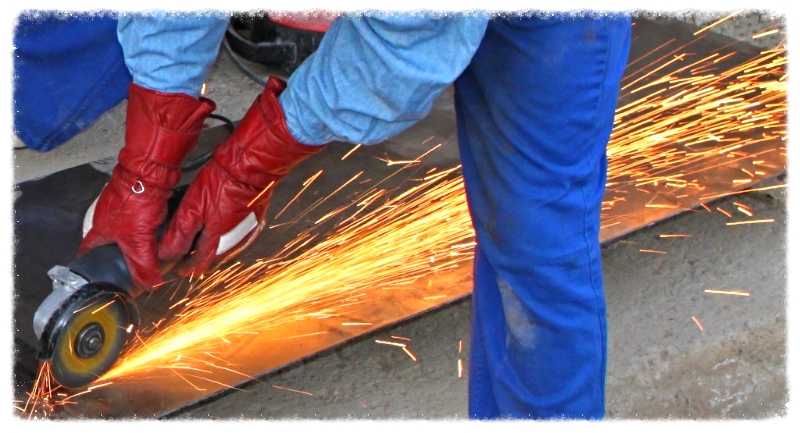
Grinder

On May 27, Metro held a meeting of the Purple Line Extension advisory group at the Petersen Museum. On the agenda was Metro’s mitigation plan for construction noise and vibration in the Miracle Mile. Metro’s PowerPoint presentation on the topic can be seen here.

The proposed mitigations offered to the community did not pass the “common sense” test with numerous residents in attendance. Nighttime work currently underway for utility relocations at Wilshire/La Brea and Wilshire/Fairfax sparked complaints from residents of the La Brea-Hancock area and from those living on Orange Street near Fairfax.

A mother of young children displayed a smartphone video she made of Metro contractors grinding welds on temporary steel plates covering a trench near La Brea and Wilshire; the late night work woke her children blocks away.

A professional recording engineer living on Orange Street argued that Metro was trying to snow residents by claiming that nighttime subway construction would not exceed nighttime ambient noise levels by more than 5 decibels. He pointed out that while that might seem to be only a slight increase in volume to the uninformed, in fact, a 5 decibel increase would nearly double the perceived nighttime ambient noise levels.

A Windsor Square resident complained that a long promised sound wall surrounding the subway construction yard at Crenshaw and Wilshire had yet to be completed – despite the fact that the utility relocation crews headquartered there began using the site many months ago.

Others inquired why nighttime utility relocation work recently detoured eastbound Wilshire traffic to 8th Street for two nights in a row; a situation that had idling and honking vehicles stacked up at the intersections of Genesee and Ogden late into the night – without traffic control officers present. Even Metro’s 720 bus was diverted to 8th, adding to the traffic noise that disturbed a number of nearby residents.

A Metro official admitted that they were having difficulty implementing practices designed to require the various utility relocation contractors to reduce nighttime noise; that it is a challenge for Metro to ensure that every construction vehicle has a low volume back-up alarm; and that, on occasion, a construction worker pulls up to the work site in the middle of the night with their car stereo blaring. This official was also unable to explain why workers were grinding welds at such a late hour, despite Metro’s often-repeated assurances that noisier work would be confined to the earlier hours of the evening.

The experiences of residents enduring the disturbances of nighttime utility relocations serves to reinforce the MMRA’s opposition to permit 24/7 activities at the Miracle Mile subway station construction sites. In their PowerPoint presentation Metro admitted that the greatest amount of noise would be generated at their Wilshire/La Brea yard, which will house a slurry recovery facility and a grout manufacturing plant – as well as serve as the location where all the dirt will be extracted from all of the tunneling from Western to La Cienega.

Once again, it was reiterated at the meeting that the contractor of the subway extension is solely responsible for mitigating noise and vibration. That the mitigations Metro touted at the meeting were only examples of mitigations that might be provided. This is why the Miracle Mile Residential Association maintains that until such time that Metro actually engages a contractor it is pointless to discuss specific noise mitigations for the subway construction sites at Fairfax and La Brea. Time and time again, the MMRA has informed Metro that it will not sign a blank check on work hours exemptions that will be cashed at the expense of the residents of the Miracle Mile.

The only way to guarantee that the neighborhood has a voice in how subway construction is conducted in the Miracle Mile is to sign the online petition opposing nighttime, Sunday, and holiday construction. This petition campaign, which has been underway since last February, has already compelled Metro to ask the Los Angeles Police Commission for a “time out” in considering their application for an exemption from work hours rules at the Miracle Mile subway construction sites.

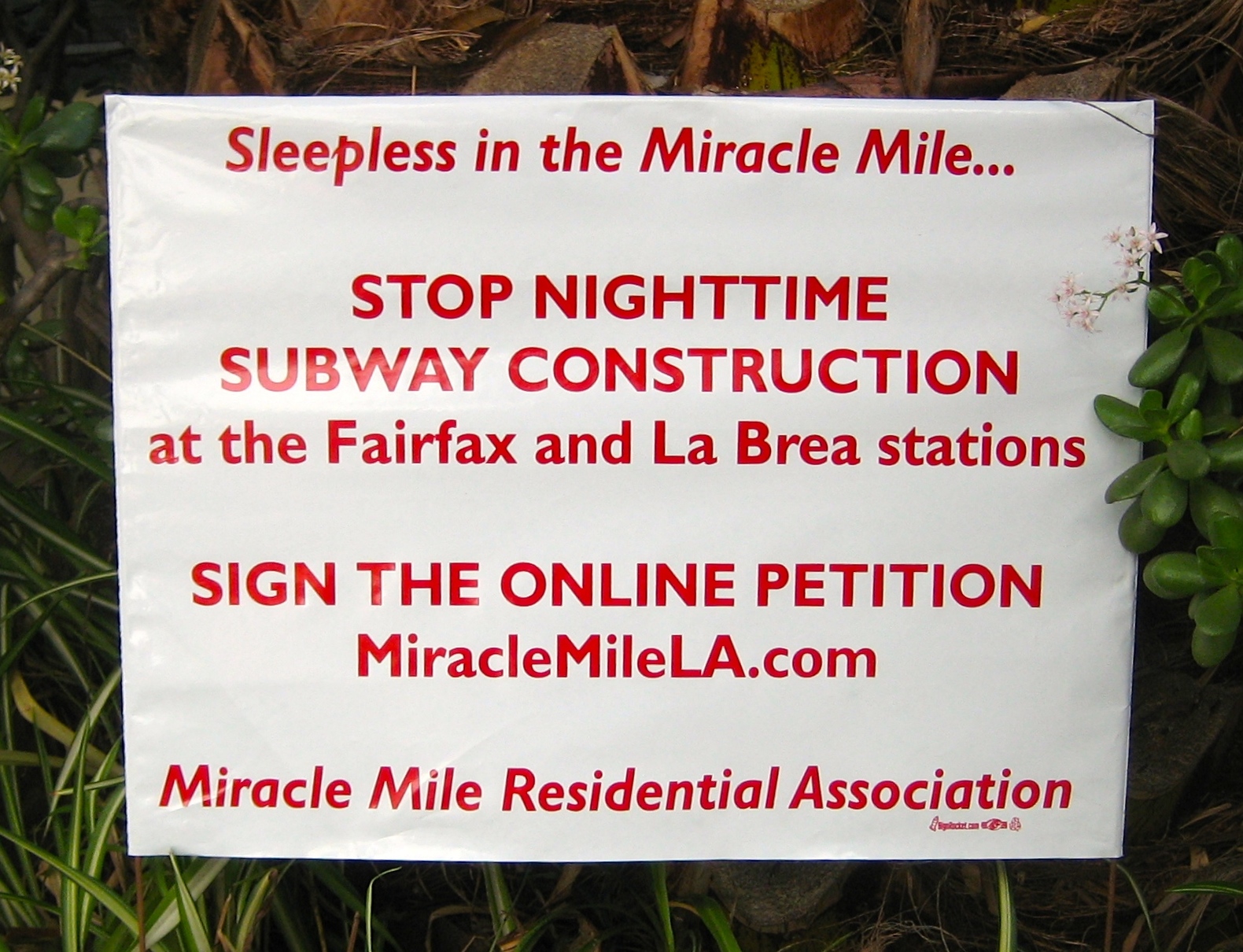
Subway Petition Lawn Sign

The MMRA’s “no blank check” stance appears to have gained traction with the Police Commission. Recently, the commission began requiring all contractors seeking work hours exemptions in the Miracle Mile to consult with the MMRA before they will consider applications for variances. This is a requirement that the commission didn’t enact before they granted permission to allow nighttime utility relocation work. Obviously, our petition campaign has provoked this policy change and the MMRA is pleased that the commission is being so responsive and respectful towards our community.

The MMRA’s petition campaign has gotten a lot of attention – and some criticism from those who mistakenly believe that we oppose the subway extension. Our objective is to balance the fundamental right of thousands of residents to enjoy the peace and quiet of their own homes with the enormous demands of a massive, decade long, multiple billion-dollar construction project. Neither side is going to get everything they want, but the MMRA will not allow the needs of the residents to be ignored no matter how important or worthy the cause.

SIGN THE ONLINE PETITION

Click here to download the printable petition

We also invite you to visit the Subway Construction page on the MMRA website. It is frequently updated with links to media coverage on our petition campaign, official correspondence, construction fact sheets and reports, YouTube videos of subway construction techniques, and other information.